Guides
EPA pesticide storage rules for US pest control businesses, explained
EPA pesticide regulations cover storage, FIFRA labeling, recordkeeping, spill reporting and enforcement penalties for US pest control businesses.
What to take away
- EPA pesticide regulations reach every jug, drum and aerosol can in your storage room, from registration and labeling to how long you keep records.
- The EPA Office of Pesticide Programs writes the federal rules; state boards such as California's Structural Pest Control Board add licensing and storage conditions on top.
- Storage rooms need locked access, spill kits, ventilation and separation of pesticides from food, PPE and application equipment.
- Records must show what came in, what went out and where it was applied, and they must survive an inspection.
- Spills that threaten water, soil or public health can trigger reporting to the National Response Center and state authorities.
- Penalties in EPA enforcement cases run from warning letters and compliance orders to civil fines per violation, per day.
What the EPA Office of Pesticide Programs regulates in a storage room
The EPA Office of Pesticide Programs administers FIFRA, the Federal Insecticide, Fungicide, and Rodenticide Act. Every pesticide your company buys, stores or applies must be registered under that law. Registration is the agency's approval that a product can be sold and used for the pests named on its label.
That approval travels with the product into your building. A registered pesticide stored in an unregistered container, decanted into a soda bottle or kept past its shelf life is a compliance problem even before anyone applies it.
The agency publishes its registration process on its About Pesticide Registration | US EPA page, which is worth reading once as an owner.
Storage rooms also fall under the broader chemical safety rules the agency groups on its Chemicals, Pesticides and Toxics Topics | US EPA hub. That hub links pesticide storage to chemical accident prevention, risk management and community right-to-know requirements.
For a pest control business, the practical effect is simple. Your storage room is a regulated space, not a shed. Inspectors can ask what is in it, how it is labeled, who has keys and what happens when a container leaks.
OSHA adds worker protection duties for the same room, covering hazard communication, PPE and emergency eyewash. The two sets of rules overlap, and passing one inspection does not guarantee the other.
Most structural pest control firms in the United States are small businesses, often with one to twenty technicians. That size does not reduce the storage rules. It just means the owner usually carries the compliance role personally.
Registration, labeling and container rules under FIFRA
FIFRA labeling and registration rules make the label the controlling document. If the label says store above freezing, you store above freezing. If it says keep away from food, the storage room layout has to reflect that.
A pesticide label carries the EPA registration number, the establishment number, the signal word, first aid statements, directions for use and storage and disposal instructions. Your technicians must follow those directions. Applying a product at a rate or site the label does not allow is a violation, even if the application works.
What the label controls
- The pests and sites where the product may be used.
- The application rate, method and re-entry interval.
- Required personal protective equipment.
- Storage and disposal conditions.
- Container handling, including triple rinsing for some products.
FIFRA also restricts container reuse. A pesticide container may not be reused for food, drink or anything a person might consume from. Repackaging a registered product into an unlabeled container is a labeling violation on its own.
State-level licensing sits alongside these federal rules. Our guide to licences and compliance covers how state boards, applicator categories and insurance requirements fit together for a US pest control firm.
Labels change. Manufacturers amend them, and the EPA approves the changes. A product you bought two years ago may carry an older label with different storage language. Keep the label with the container, or keep a current copy in your records.
Restricted-use pesticides add a layer. Only certified applicators or people under their direct supervision may use them, and some states require additional permits to store them. Check your state board's list before you stock a restricted-use product.
Recordkeeping and inventory practices EPA expects
Recordkeeping requirements under FIFRA are not one federal form. The law sets the framework, and the EPA and state lead agencies define what records a business must keep and for how long. For most pest control operations, that means purchase records, application records, inventory counts and disposal documentation.
Application records typically include the date, the applicator, the product and EPA registration number, the amount used, the target pest and the site treated. Many states require these records within a set number of hours of the application and retention for at least two years.
A worked example
A three-technician firm in Phoenix buys a case of a liquid concentrate in March. The invoice shows the EPA registration number and lot. In April, technicians apply part of the case at two commercial accounts. In July, a container leaks in the storage room.
If the firm kept the purchase invoice, the application logs and an inventory count, it can show exactly how much product left the shelf and how much remains. If it kept nothing, the inspector cannot tell whether product was applied legally, stored illegally or lost. The paperwork is the defense.
Inventory counts also catch shrinkage. A missing quart of concentrate may mean a spill nobody reported, a theft or an unrecorded application. Any of those is a problem worth finding before an inspector does.
A written compliance checklist for new owners helps a small firm build these records from day one instead of reconstructing them after a notice of violation.
Keep records where you can produce them during an inspection, not in a personal email account. Paper binders, shared drives and field service software all work if the records are complete and retrievable.
Spill reporting and emergency response obligations
Spill reporting under EPA emergency response rules depends on what spilled, how much and where it went. A small spill contained inside the storage room is usually a cleanup and internal report. A spill that reaches a storm drain, ditch, creek or soil can become a reportable release.
The EPA's Emergency Response | US EPA page explains the federal response framework and the reporting channels for releases of hazardous substances, including many pesticide products. When a release meets the reportable quantity, the National Response Center is the federal contact point.
What to do when a container fails
- Get people out of the immediate area and stop the source if it is safe to do so.
- Check the label and safety data sheet for the product's hazards and first aid steps.
- Contain the liquid with absorbent material from your spill kit and keep it out of drains.
- Notify your supervisor and decide whether the release is reportable under federal or state rules.
- Report to the required agencies within the required time, then document the cleanup and disposal.
Never hose a pesticide spill into a floor drain. That turns a room problem into a water problem and can trigger reporting thresholds you would otherwise avoid.
Your written standard procedures should name who calls whom after a spill, including the after-hours contact. A spill at 9 p.m. should not wait for the owner's morning coffee.
Some states require immediate notification to their department of agriculture or environmental agency as well. Keep those numbers posted in the storage room, next to the spill kit.
How EPA compliance monitoring and enforcement penalties work
The EPA's Compliance | US EPA page describes how the agency monitors regulated businesses, responds to tips and inspections, and escalates enforcement when a violation is found. Inspections can be routine, complaint-driven or part of a broader sector sweep.
Enforcement usually starts with an inspector's findings and a chance to correct. Minor paperwork gaps often end in a warning letter or an informal compliance agreement. Repeated or serious violations move up the scale.
Penalties cited in EPA enforcement cases
- Warning letters and notices of violation that require corrective action.
- Compliance orders that set deadlines and sometimes halt a practice.
- Civil administrative penalties assessed per violation, with higher amounts for repeat or knowing violations.
- Criminal penalties for knowing violations that endanger people or the environment.
- Suspension or cancellation of a product registration in extreme cases.
The exact dollar figures depend on the statute, the violation type and whether the case settles. What matters for an operator is that penalties are typically counted per violation and sometimes per day, so a single storage room with ten mislabeled containers is not one problem.
The EPA also considers a company's compliance history and its ability to pay. A small pest control business that fixes a problem quickly and documents the fix usually fares better than one that ignores a warning letter.
FIFRA sits inside the broader body of federal environmental law described on the EPA's Laws & Regulations | US EPA landing page. If you want to read the statute itself, that page is the starting point.
Storage checklist for a pest control business
Use this storage room checklist as a quarterly self-inspection. Print it, walk the room and write down what fails. A checklist you never fill out is decoration.
- Pesticides stored in original, labeled containers with the EPA registration number visible.
- No pesticide decanted into food, drink or unlabeled containers.
- Storage room locked, with access limited to trained and authorized staff.
- Ventilation adequate for the products stored, with no odors escaping to occupied areas.
- Pesticides separated from food, animal feed, PPE, clothing and application equipment.
- Spill kit stocked with absorbent, PPE, containers and disposal bags.
- Shelving stable, with heavy containers low and liquids below dry products.
- Temperature kept within label limits, especially for products that freeze or degrade.
- Inventory list current, with quantities and dates received.
- Safety data sheets on file and accessible to workers.
- Emergency numbers posted, including poison control, the National Response Center and state contacts.
- Fire extinguisher inspected, and no ignition sources near flammable products.
- Expired or unusable product segregated and scheduled for proper disposal.
- Application records and purchase invoices filed and retrievable.
Run the same eye over your vehicles. A truck bed in a Texas summer is a storage location, and the label conditions still apply.
New hires should walk this checklist during onboarding. Our guide to pest control license requirements covers what to document for each technician, including storage and handling duties.
Equipment matters too. Pumps, hoses and sprayers that sit in the storage room should be clean and drained, as outlined in this equipment checklist, so residue does not contaminate the room or the next job.
Where state boards add rules on top of EPA requirements
State pest control licensing boards regulate the businesses and the applicators, while the EPA regulates the products. Both apply at once. A California structural pest control company answers to the state board for licensing and to the EPA for product storage and use.
States can be stricter than the federal rules. California, New York and Washington have layered environmental and pesticide rules that go beyond FIFRA in areas such as notification, buffer zones and storage conditions. Texas, Florida, Arizona, Illinois and Georgia each run their own licensing and recordkeeping systems.
Some states require a designated storage area with specific containment, posted warning signs or a permit for certain products. Others require applicators to carry licenses and to file reports of pesticide use on a set schedule.
How to keep both sets straight
- Read your state board's storage and recordkeeping rules once a year.
- Keep the state license and the EPA registration paperwork in the same file.
- Ask your supplier for the current label and safety data sheet with each order.
- Train technicians on both the federal label and the state reporting forms.
Industry associations such as the National Pest Management Association publish updates when rules change, and state boards send notices to licensed firms. Those notices are worth reading rather than filing.
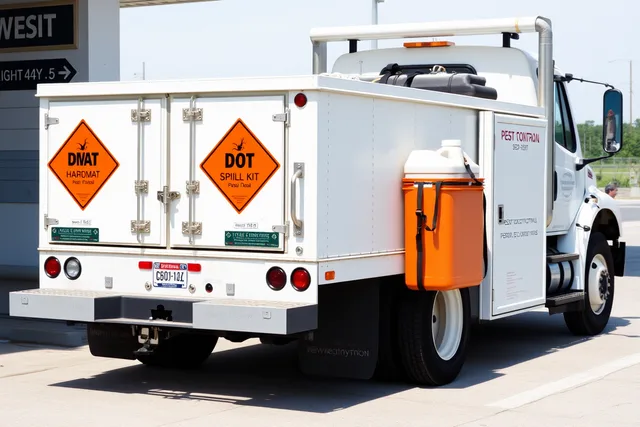
Transportation adds another layer. DOT rules govern how pesticides travel in your vehicles, including placarding and container securement. A spill on the road can involve DOT, the EPA and state authorities at once.
Common questions
Do I need a separate storage building for pesticides? No federal rule requires a separate building, but the space must be locked, ventilated and separated from food, PPE and living areas. Some states impose stricter containment rules.
How long must I keep pesticide records? Federal rules set a framework, and states usually require application records for at least two years. Many firms keep them longer because liability claims can arrive years later.
Can I pour leftover pesticide into a smaller unlabeled container? No. Repackaging into an unlabeled container is a labeling violation. Keep product in its original container or follow the label's instructions for transfer.
When must I report a spill? When the release meets a reportable quantity or threatens water, soil or public health. The National Response Center is the federal contact, and states often require separate notification.
What happens if an EPA inspection finds violations? Outcomes range from a warning letter to civil penalties counted per violation, and in serious cases criminal charges. Correcting the problem quickly and documenting it usually helps.
Does FIFRA apply to a one-person pest control business? Yes. FIFRA applies to any business that distributes, stores or applies registered pesticides, regardless of size.