Guides
DOT rules for transporting pesticides in Texas and Florida compared
DOT pesticide transportation rules for Texas and Florida pest control fleets differ on placarding, driver training, enforcement, and spill kit requirements.
What to take away
- DOT pesticide transportation rules apply to pest control vehicles when they carry hazardous materials above threshold weights or in certain packaging.
- Texas inspects placarded loads through DPS commercial vehicle enforcement at weigh stations on I-10, I-35 and I-45, while Florida leans on FHP scales and FDACS agricultural inspection stations at its entry points.
- Driver training requirements include general awareness, function-specific, and safety training, with documentation that must be kept current.
- Spill kits, securement, and vehicle inspections are critical for compliance and safety during pesticide transport.
- A transport compliance checklist helps pest control companies avoid fines and keep routes running smoothly.
When a pest control truck becomes a hazmat vehicle under DOT rules
A pest control truck becomes a hazmat vehicle when it carries pesticides that meet the Department of Transportation's definition of hazardous materials. Many pesticides are regulated because they are toxic, flammable, or corrosive. The DOT's Pipeline and Hazardous Materials Safety Administration sets the rules.
If your truck hauls these materials in quantities that require placarding, or in packaging that exceeds certain limits, you are operating a hazmat vehicle. This triggers a range of requirements, from driver training to vehicle marking. For pest control companies, the key is to know the materials you carry and their hazard classes.
Common pesticide active ingredients like organophosphates and pyrethroids may fall under hazard class 6.1, toxic substances. Some formulations are class 3, flammable liquids, or class 8, corrosives.
The DOT hazmat rules for pest control vehicles apply whether you cross state lines or stay within Texas or Florida. Even intrastate commerce is covered if the vehicle meets the definition.
The Federal Register publishes updates to these rules, and businesses should monitor changes. You can find relevant notices on the Federal Register business and industry topic.
A threshold question is whether the pesticide is in a consumer commodity or a regulated form. Consumer commodities are excepted from many requirements if packaged for retail sale and in limited quantities. But pest control operators often use concentrated products in larger containers. Those are more likely to trigger full hazmat regulation.
The EPA also regulates pesticides under the Federal Insecticide, Fungicide, and Rodenticide Act. The EPA laws and regulations landing page explains the statutes. However, DOT rules focus on transportation safety. So a pesticide can be an EPA-regulated product and a DOT hazmat at the same time.
Your vehicle becomes a hazmat vehicle when the quantity or packaging crosses DOT thresholds. For example, if you carry more than 1,001 pounds of a single hazardous material in one vehicle, placarding is required. That is a common threshold. But other thresholds exist for different hazard classes and packaging types.
Pest control companies should check the DOT Hazardous Materials Table for their specific products. The table lists proper shipping names, hazard classes, and ID numbers. Without that check, you might assume you are exempt when you are not. Review your fleet against the equipment checklist before the season starts.
Placarding thresholds for pesticides carried in Texas and Florida
Placarding thresholds are federal, but Texas and Florida enforce them through their own agencies. The federal threshold for most hazardous materials is 1,001 pounds aggregate gross weight. That means if you carry 1,001 pounds or more of a hazmat in one vehicle, you must placard.
For pesticides in hazard class 6.1, the threshold may be lower if the material is in packing group I or II. Some pesticides are assigned to packing group I, which has a threshold of any amount. That means even small quantities require placards.
Pest control companies often carry multiple containers. The aggregate weight counts everything in the vehicle. So if you have several 5-gallon jugs of a toxic pesticide, you could reach the threshold quickly. Placards must be displayed on all four sides of the vehicle and must match the hazard class of the material.
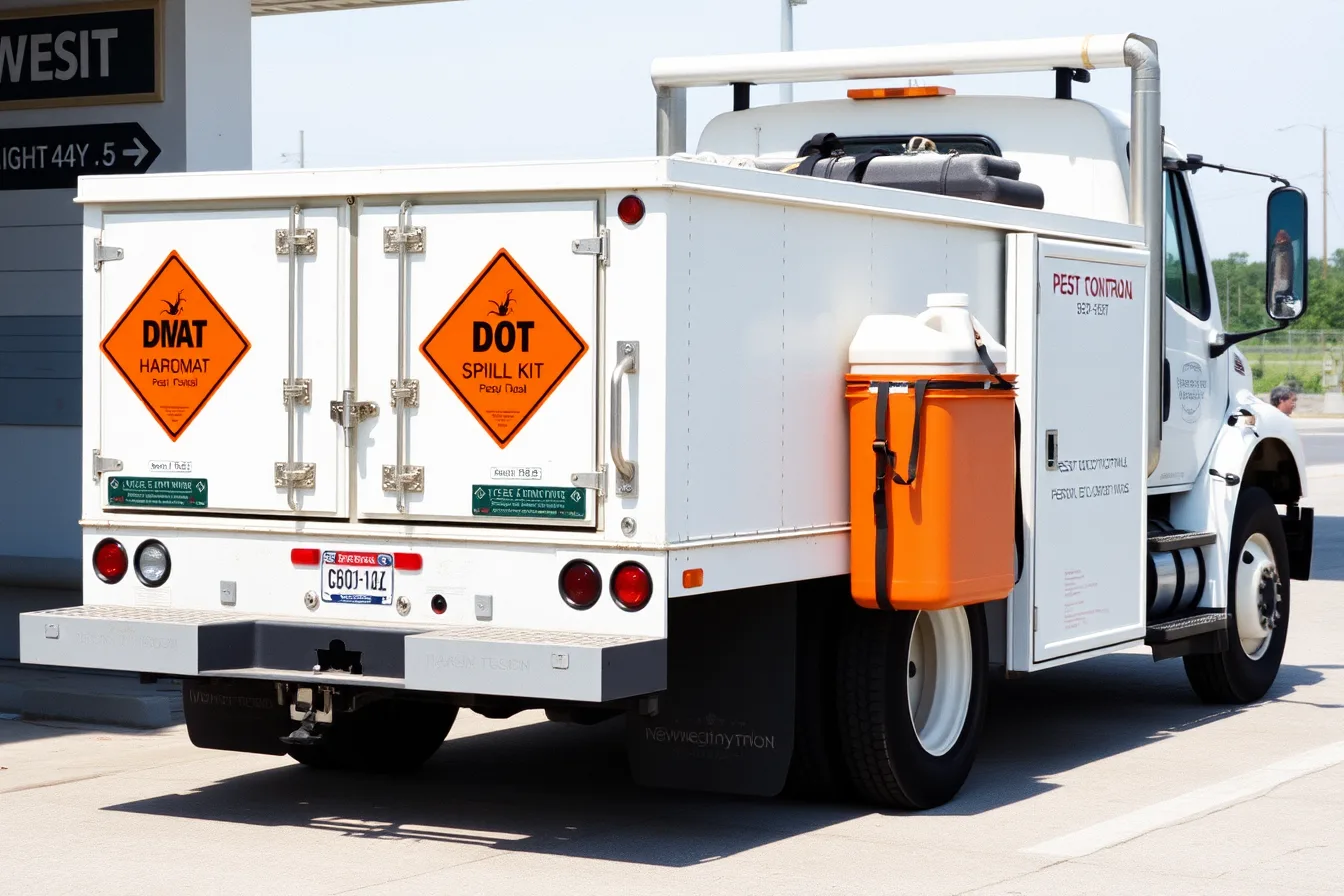
For class 6.1, the placard is white with a skull and crossbones. For class 3, it is red with a flame. For class 8, it is black and white with a corrosion symbol. Texas and Florida do not have different placard designs. They use the federal system. But enforcement differences exist.
Texas Department of Public Safety troopers may conduct roadside inspections. Florida Highway Patrol does the same. Both look for placards when required. Texas DPS works the Houston, Beaumont and Dallas corridors where chemical traffic is heavy. Florida troopers watch the agricultural belt around Immokalee and the I-4 corridor.
The current Federal Register issue can show recent rule changes that affect thresholds. Always verify the latest before assuming an exemption.
In Texas, the state adopts federal hazmat regulations by reference. The Texas Administrative Code includes these rules. The Texas Department of Motor Vehicles registers vehicles, but hazmat enforcement falls to DPS. Florida also adopts federal rules. The Florida Department of Highway Safety and Motor Vehicles oversees compliance. Neither state offers a blanket exemption for pest control vehicles.
Some states have intrastate exemptions for certain agricultural operations. But pest control is generally not considered agricultural for hazmat purposes. That means you must follow placarding rules even for short trips within a city. For example, a route in Houston or Miami that carries 1,200 pounds of a class 6.1 pesticide requires placards.
If you carry less, you may not need placards, but you still need to follow other rules like shipping papers and emergency response information. Placarding is just one part. The threshold is based on the total weight of all hazardous materials in the vehicle. If you carry two different hazmats, you add their weights.
So a truck with 600 pounds of a toxic pesticide and 500 pounds of a flammable one would cross the 1,001-pound threshold. That is a common mistake. Pest control companies should train drivers to calculate aggregate weights. A simple log of what is loaded each day helps.
The placarding threshold is not the only trigger. Some materials require placards regardless of weight if they are in certain packaging. For instance, if you carry a poison inhalation hazard, placards are required at any quantity. Check the DOT Hazardous Materials Table for special provisions. Fold placard checks into the working rhythm of every route.
Driver training and documentation requirements in each state
Driver training is required for all hazmat employees, which includes drivers who handle or transport hazardous materials. The training must cover general awareness, function-specific, safety, and security awareness. It must be repeated every three years. New drivers must be trained before they can operate a hazmat vehicle.
The training can be provided in-house or by a third party. Documentation of training must be kept by the employer. It includes the driver's name, the date of training, and the materials covered. Texas and Florida both require this documentation. But Texas may ask for it during a roadside inspection. Florida often checks it during audits.
The DOT does not issue a hazmat driver's license. Instead, the training is tied to the employer's compliance program. Some drivers may need a commercial driver's license with a hazmat endorsement if the vehicle meets certain weight or material criteria.
For pest control vehicles, a CDL may be required if the vehicle weighs over 26,001 pounds or carries certain quantities of hazardous materials.
Many pest control trucks are smaller, so a CDL may not be needed. But the training is still required. The OSHA employer compliance resources provide guidance on training that overlaps with DOT requirements. OSHA's hazard communication standard requires training on chemical hazards. That can be combined with DOT training to save time.
In Texas, the Department of Public Safety may conduct inspections at weigh stations or on the road. They will ask for training records and shipping papers. Florida's Highway Patrol also conducts inspections. Both states require that the training be documented and available. The documentation must be in English and include the required elements.
If a driver is not trained, the employer can be fined. Fines can be substantial. The DOT's penalties are adjusted for inflation. As of 2026, the maximum fine for a training violation can exceed $80,000 per violation. That is a strong incentive to keep records current.
Pest control companies should also consider the licences and compliance requirements for their state pesticide licenses. Those are separate from DOT rules but equally important. Some states require additional training for pesticide applicators. Texas and Florida both have pesticide applicator licensing through their agriculture departments. That training does not replace DOT training.
Drivers need both if they apply pesticides and transport them. Documentation should be kept for at least three years. Some companies keep it longer in case of audits. A simple spreadsheet can track training dates and expiration. Set reminders before the three-year mark.
The training must be specific to the materials the driver handles. If a driver only carries class 6.1 pesticides, the training should cover that class. If they carry multiple classes, training must cover each. Security awareness training is also required for materials that could be used in a terrorist act.
Many pesticides are not on the security-sensitive list, but some are. Check the DOT list of security-sensitive materials. If your materials are on it, you need a security plan. That plan must be in writing and available for inspection.
Vehicle inspection, securement and spill kits for pesticide transport
Vehicle inspection is a daily responsibility. Drivers should inspect the vehicle before each trip. They look for leaks, damaged containers, and proper placards. The inspection should be documented. A checklist helps ensure nothing is missed.
Securement is also critical. Pesticide containers must be secured to prevent movement during transport. They should not be able to slide or tip. Use straps, load bars, or shelves with lips. Do not stack containers if they can fall.
Spill kits are required for hazmat transport. The kit should include absorbent materials, a containment boom, protective gloves, goggles, and a disposal container. The kit must be appropriate for the materials carried. For pesticides, absorbents that can handle liquids are needed.
The DOT requires emergency response information for each hazmat. That information must be kept in the cab. It includes a 24-hour emergency response telephone number. The number must be monitored at all times. The EPA's emergency response page provides guidance on spill reporting.
If a spill occurs during transport, it may need to be reported to the National Response Center. The EPA also has requirements for pesticide spills under FIFRA. Reporting thresholds vary by material. Drivers should know the reporting requirements for the pesticides they carry.
A spill kit is not just for compliance. It helps protect the environment and public health. Pest control companies should train drivers on how to use the kit. They should also have a procedure for disposing of spilled materials. That procedure must follow EPA and state rules.
In Texas, the Department of Transportation may inspect vehicles at random. Florida also conducts inspections. Both states require that spill kits be readily accessible. The kit should be in a location that is easy to reach from the driver's seat. It should not be buried under other cargo.
The kit should be inspected regularly. Replace used or expired items. For example, absorbents can lose effectiveness over time. Gloves can degrade. A monthly check is a good practice. Write these checks into your standard procedures so they happen on schedule.
The DOT also requires that vehicles carrying hazmat be marked with the proper placards and identification numbers. The identification number is a four-digit code from the Hazardous Materials Table. It must be displayed on the vehicle or on the placard.
For pesticides, the ID number is specific to the material. For example, a common toxic pesticide might have ID number UN2990. That number must be on the shipping paper and on the vehicle if placarded.
Securement also includes making sure containers are closed and not leaking. If a container is damaged, it should not be transported. Drivers should have a way to contain a leaking container. An overpack drum can be used. That is a larger container that holds the leaking one. It must be compatible with the material.
The spill kit should include an overpack drum if the volume of materials carried warrants it. Pest control companies should assess their routes and the quantities they carry. A route with large quantities may need a more comprehensive spill kit. Pair that kit with the right pest control equipment for your vehicles.
How Texas and Florida enforcement differences show up in practice
Texas and Florida both enforce federal hazmat rules, but the checkpoints look different. Texas DPS Commercial Vehicle Enforcement staffs fixed weigh stations along I-10, I-35, I-45 and I-20, and troopers there can pull a placarded truck in for a full Level I inspection. Chemical traffic around Houston and Beaumont means pesticide loads get looked at often.
Florida splits the job between two agencies. FHP Commercial Vehicle Enforcement runs weigh stations on I-75, I-95 and I-10. The state's FDACS agricultural inspection stations also stop trucks at major entry points, so a load crossing into Florida on I-10 near Pensacola or I-75 near Jennings can be checked before it ever reaches a customer.
In practice, a pest control company operating in Texas may see more roadside inspections. They should be prepared with all documentation. In Florida, inspections may be less frequent but still possible. Both states use the same federal penalties.
But state penalties can be added. For example, Texas can assess fines for commercial vehicle violations. Florida can suspend a vehicle's registration for certain violations.
Companies should also be aware of local ordinances. Some cities in Texas and Florida have additional requirements for hazmat transport. For instance, Houston and Miami may have restrictions on routes. Check local rules before planning routes. Your daily procedures should include a pre-trip check for local restrictions.
Enforcement differences also show up in how training records are checked. Texas may ask for them at weigh stations. Florida may request them during a compliance audit. Both states require that records be kept for three years.
But Texas may be more likely to issue a citation on the spot if records are missing. Florida may give a warning and follow up.
Companies should not rely on leniency. Always have records ready. The DOT also conducts its own inspections. Federal inspectors can show up at any time. They have the same authority as state inspectors. So even if state enforcement is light, federal enforcement can be strict.
Another difference is how states handle intrastate versus interstate transport. Texas and Florida both regulate intrastate hazmat transport. But the rules may be slightly different for intrastate. Some states have exemptions for certain intrastate operations. Texas and Florida generally do not exempt pest control.
So if you operate only within Texas, you still need to follow federal rules. That includes placarding and training. Some companies mistakenly believe that intrastate transport is exempt. That is not true. The federal rules apply to intrastate commerce as well. The DOT has the authority to regulate intrastate hazmat transport.
Texas and Florida have adopted the federal rules. They may add state-specific requirements. For example, Texas requires certain vehicles to have a Texas DOT number. Florida requires a Florida DOT number for some vehicles. Those numbers are for identification. They do not replace federal requirements.
Companies should register with the state if required. The registration process may include a safety audit. That audit can check hazmat compliance. So even if you are not inspected on the road, you may be audited at your place of business. Keep all records organized. A simple filing system for training, inspections, and shipping papers works.
A transport compliance checklist for pest control routes
Use this checklist before each route. It covers the key DOT requirements for pesticide transport. Adapt it to your specific materials and vehicles.
- Verify the hazard class and packing group of each pesticide on board.
- Calculate the total weight of all hazardous materials to determine if placarding is required.
- Ensure placards are displayed on all four sides if required.
- Check that shipping papers are complete and include the proper shipping name, hazard class, ID number, and packing group.
- Confirm emergency response information is in the cab, including a 24-hour emergency phone number.
- Inspect the spill kit for completeness and accessibility.
- Secure all containers to prevent movement.
- Verify that the driver's hazmat training is current and documented.
- Check that the vehicle has the required markings and identification numbers.
- Review local route restrictions for hazmat transport.
This checklist is a starting point. The DOT requires more detailed procedures for some materials. For example, if you carry a poison inhalation hazard, you need a security plan. If you carry large quantities, you may need a written route plan.
The checklist should be reviewed regularly. Update it when regulations change, and watch the Federal Register for new rules. Train drivers to use the checklist every day. Keep completed checklists for at least three years.
Completed checklists can serve as evidence of compliance during an inspection. If you are audited, you can show that you are following the rules. That can reduce fines or penalties.
Common questions
What is the placarding threshold for pesticides? The federal threshold is 1,001 pounds aggregate gross weight for most hazardous materials. Some pesticides in packing group I require placards at any amount. Check the DOT Hazardous Materials Table for your specific product.
Do I need a CDL to transport pesticides in Texas or Florida? A CDL with a hazmat endorsement is required if the vehicle weighs over 26,001 pounds or carries certain quantities of hazardous materials. Many pest control trucks are smaller, so a CDL may not be needed. But hazmat training is still required.
How often must hazmat training be repeated? Training must be repeated every three years. New drivers must be trained before they operate a hazmat vehicle. Documentation must be kept for at least three years.
What should be in a spill kit for pesticide transport? A spill kit should include absorbents, a containment boom, protective gloves, goggles, and a disposal container. It should be appropriate for the materials carried and inspected regularly.
Are intrastate pesticide transports exempt from DOT rules? No. Federal DOT hazmat rules apply to intrastate commerce as well. Texas and Florida both adopt these rules. Some exemptions exist for certain agricultural operations, but pest control is generally not exempt.
How do Texas and Florida enforcement differ? Texas DPS runs fixed weigh stations on I-10, I-35 and I-45, and troopers there can order a Level I inspection. Florida uses FHP scales along I-75, I-95 and I-10 plus FDACS agricultural inspection stations at entry points, so a load can be checked well before it reaches the route.