Guides
The bookkeeping routine that keeps a pest control business solvent
A pest control bookkeeping routine ties each spring callback, chemical draw and truck repair to the week it lands, so cash never surprises you.
What to take away
The bookkeeping routine that keeps a pest control business solvent is a cadence: five steps each week, three numbers each month, and a cash reserve set before spring.
- Book a weekly 45-minute close: deposit every payment, code every chemical and part draw, and match each invoice to a service address.
- Track three numbers monthly: revenue per completed stop, callback rate by technician, and days of cash on hand.
- Keep the chart of accounts short: 1000 Checking, 1200 Accounts Receivable, 1300 Chemical Inventory, 4000 Service Revenue, 5000 Cost of Services.
- Hold a spring reserve equal to one month of payroll before March, because emergence season front-loads chemical and fuel spend.
- Reconcile the chemical inventory against the label records you already keep for the EPA-registered products you apply.
- Review route density and pricing each quarter against the numbers in your pest control software and KPI guide.
This article covers pest control business operations, not pest identification, pesticide selection, application rates or treatment protocols. Label directions and a licensed applicator govern every application. Confirm licensing, tax and insurance duties with your state pesticide regulatory agency and a qualified professional.
The weekly close
Pick one hour, same day each week, and do the same five things in the same order.
- Deposit every check, card batch and ACH payment from the week and record the deposit date against each invoice.
- Code each chemical draw to the service address that consumed it, using the amount recorded on the label use log.
- Code fuel, parts and equipment repairs to the truck that incurred them, not to a general overhead bucket.
- Match every completed work order to an invoice; flag any stop finished more than three days ago without one.
- Reconcile the bank balance and note any payment more than 30 days past due.
Step two posts to 5010 Chemicals. Step three posts to 5020 Fuel or 5030 Repairs, with the truck number in the memo line. That memo is what turns a pile of receipts into cost per truck in December.
Three checks close the hour. Void or chase any check outstanding more than 90 days. Tie the Accounts Receivable aging to the 1200 balance on the general ledger. Put a name next to every invoice more than 30 days past due.
Forty-five minutes a week beats a three-day catch-up at quarter end, because the details are still fresh and the technician who did the work is still reachable.
The monthly numbers
Three figures tell you whether the routine is working.
| Number | How to calculate it | What a drift means |
|---|---|---|
| Revenue per completed stop | Total service revenue divided by stops completed | Route density is falling or pricing has not moved with cost |
| Callback rate by technician | Return visits divided by that technician's completed stops | Training gap, product choice, or a site the original inspection under-read |
| Days of cash on hand | Cash balance divided by average daily operating spend | Spring reserve is too thin for emergence season |
| Chemical cost per completed stop | Chemical spend in 5010 divided by stops completed | A draw coded to the wrong address, or a supplier increase you never priced through |
| Days sales outstanding | Accounts receivable divided by average daily revenue | Collections slipping past the 30-day mark |
The callback figure matters most in spring. A technician whose callbacks climb in April is costing you fuel, chemical and a slot you could have sold.
Month end adds four chores: reconcile every bank and card account, tie the AR aging to the ledger, count the chemical shelf, and file sales tax on services where your state charges it.
QuickBooks Online, Xero and FreshBooks handle the ledger for a one to five person office. Wave offers a free accounting tier and earns on card processing.
Pest-specific platforms, among them PestPac, Briostack, FieldRoutes, Jobber, Housecall Pro and ServiceTitan, run scheduling, routing and job costing. Accounting plans typically run $30 to $115 a month as of 2026. Field platforms typically run $100 to $500 a month per office, often priced per user.
The spring reserve
Spring emergence fills the schedule and empties the chemical shelf at the same time. Set the reserve before the season, not during it.
Work out one month of payroll, add your average monthly chemical spend from last spring, and add a fuel figure based on last year's March and April mileage. That total is your target balance on 1 March.
A three-truck example: $18,000 of payroll, $4,500 of spring chemical and $1,200 of fuel set a $23,700 target. If you cannot reach it, the gap is a pricing or route-density question, not a borrowing question.
Equipment sits in the same reserve. A spray rig, a termite pump or a rodent exclusion truck that fails in May costs more to fix than the same failure in January, because you are paying overtime to cover the route while it is down.
Records the routine depends on
Your books are only as good as the field records feeding them. Keep the work order, the label use log for each EPA-registered product, the payment record and the customer authorization together, filed by service address.
Federal rules require certified applicators to keep restricted-use pesticide application records for two years, and some states require longer. That same log feeds 5010 Chemicals.
The IRS accepts any recordkeeping system that clearly shows income and expenses, provided you keep the documents behind purchases, sales, payroll and assets. Internal Revenue Service: What kind of records should I keep? sets out what that covers.
Payroll adds its own paperwork: Form 941 each quarter, Form 940 by 31 January, and W-2s for employees. Subcontractors paid $600 or more in a year get Form 1099-NEC.
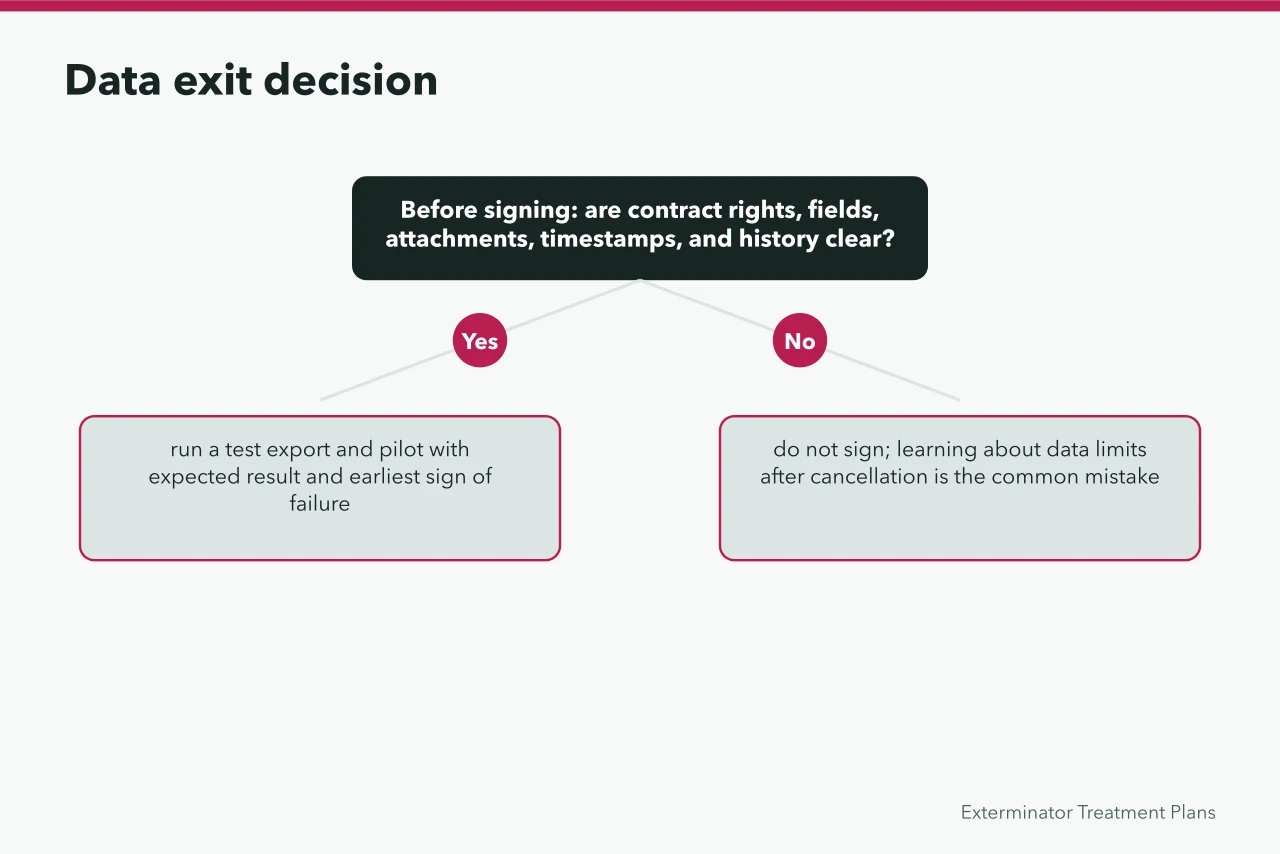
If your records live in software, settle the exit question before you sign. Check contract rights to your fields, attachments and history, plus export formats, frequency and deletion terms, and run a test export.
A pest control business plan should name who owns that check and when it is repeated.
Once the routine is steady, choosing where to open a pest control business is the next decision the numbers should inform.
Where the money leaks
Three leaks account for most of the gap between a busy month and a profitable one.
- Unbilled callbacks. A return visit on a treatment that did not hold is a cost with no invoice attached. Count them monthly.
- Chemical drawn but not logged. If the shelf empties faster than the logs say, the difference is a pricing error you are absorbing.
- Deferred equipment repair. A pump rebuild postponed twice usually costs more than the rebuild plus the overtime it caused.
The callback rate catches the first leak, 1300 Chemical Inventory catches the second, and 5030 Repairs catches the third. None of these need new software. They need the weekly close to actually happen.
Protecting the records themselves
Your ledger, customer list and payment history are the business. Two federal resources give small operators a starting checklist.
National Institute of Standards and Technology: NIST Small Business Quick-Start Guides covers practical cybersecurity and privacy risk management for small organizations, including the Cybersecurity Framework 2.0.
Cybersecurity and Infrastructure Security Agency: Cyber Guidance for Small Businesses keeps current guidance aimed at the digital and operational risks small and midsize firms face.
Back up the books off-site, restrict who can edit payment records, and test a restore once a year. Turn on multi-factor authentication for the accounting login and send a change of bank details through a second signer.
Common questions
How long does the weekly close take?
Forty-five minutes once the habit is set, longer for the first month while you clean up old entries. The cost of skipping it shows up as a three-day catch-up at quarter end and as callbacks nobody billed.
What if I run the office and the routes?
Do the close on the same evening each week, after the last stop, and keep it to the five steps. If it grows past an hour, you are reconciling history rather than recording the week.
Should the reserve cover equipment too?
Yes. A spray rig or exclusion truck that fails during spring emergence costs more than the same failure in a slow month, because you cover the route with overtime while it is down.
Which accounts does a pest control chart of accounts need?
Start with 1000 Checking, 1200 Accounts Receivable and 1300 Chemical Inventory. Vehicles and equipment sit in 1500, payables in 2000, payroll liabilities in 2200. Revenue runs to 4000, with chemicals, fuel and repairs in 5010, 5020 and 5030.
What filings should a pest control operator expect each quarter?
Sales tax on services where the state charges it, plus payroll deposits on the schedule Form 941 sets. Federal estimated tax payments come due in April, June, September and January.