Guides
Pest Control Insurance Cost in Canada: What Owners Pay
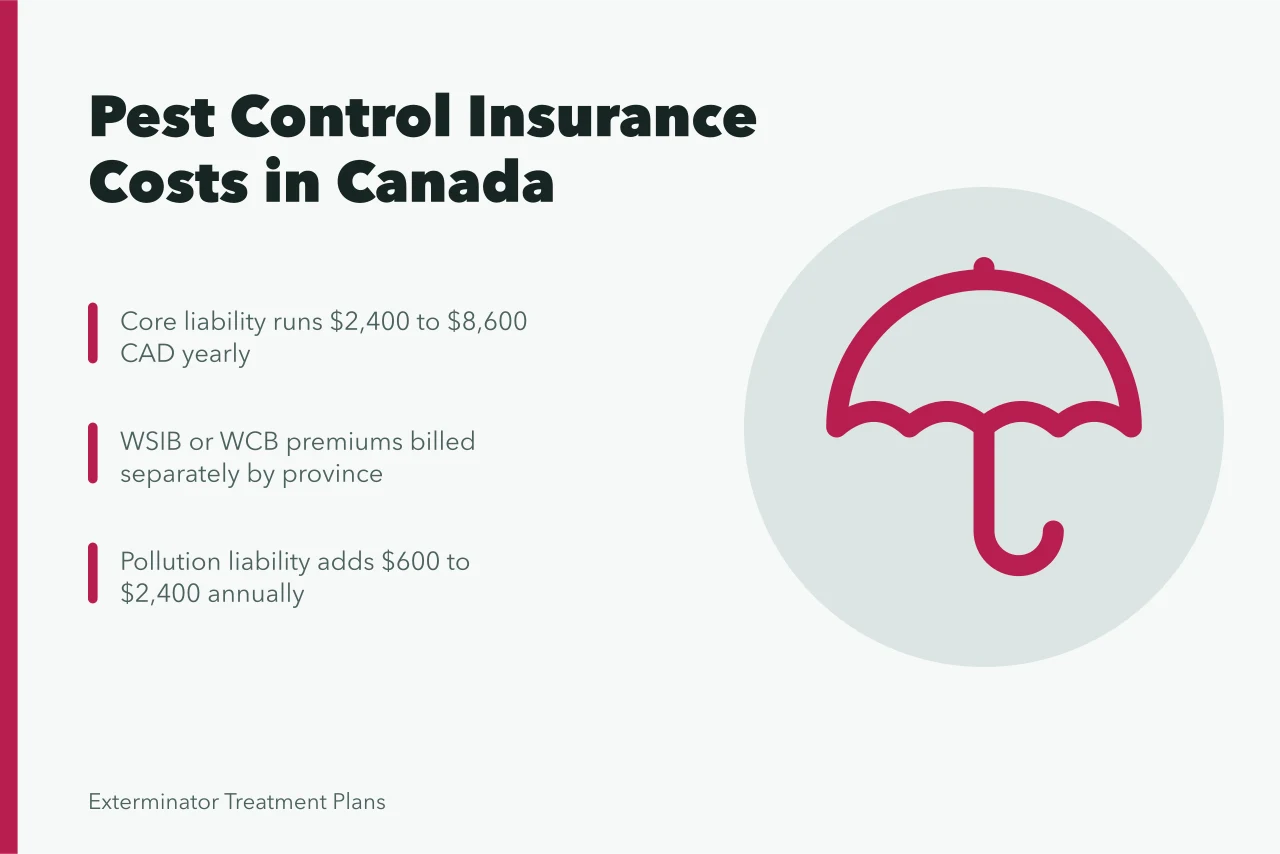
Pest control insurance cost in Canada runs roughly $2,400 to $8,600 CAD a year for core liability, with WSIB or WCB billed separately by province.
What to take away
- Canadian pest control insurance splits into commercial general liability and a separate provincial workers' compensation account, often labelled WSIB in Ontario and WCB in most other provinces.
- Core liability for a small operator commonly runs $2,400 to $8,600 CAD a year, while WSIB or WCB premiums are extra and scale with payroll.
- Quotes often leave out pollution liability endorsements, commercial vehicle coverage for service vans, and tools and equipment floaters, so owners must ask for each line.
- Owners overspend by renewing without updated revenue figures, keeping low deductibles on small property claims, or not training technicians to reduce claims.
Core liability and provincial workers' compensation
Canadian pest control liability insurance has two distinct parts: private coverage and a provincial workers' compensation account. Canadian owners do not buy one 'pest control insurance' policy. They buy a commercial general liability package and, separately, register with the provincial workers' compensation board. In Ontario that board is WSIB; in Alberta, British Columbia, and most other provinces it is WCB.
The liability package covers property damage and bodily injury claims from a treatment, such as a customer alleging a spill damaged flooring. The workers' compensation account covers technician injuries and is mandatory once you have employees or, in some provinces, even as a working owner.
Before a quote is finalized, insurers ask which pesticide classes you handle. Health Canada's pest management overview sets out federal registration and label rules, and underwriters use those classes to set your rate. In Ontario, the Pesticides Act, 1990 requires a licence for many commercial treatments, and insurers will ask for that licence number before binding coverage.
What owners actually pay, line by line
Most owners see these line items on invoices or annual statements. The figures below are illustrative ranges for a small Ontario operator with two technicians and one service van. Premiums vary by city, claims history, and deductible.
Show the numbers
| Commercial general liability, $2 million limit | $1,200–$3,800 |
|---|---|
| Pollution liability endorsement | $600–$2,400 |
| Commercial vehicle insurance, one service van | $1,800–$4,200 |
| WSIB premiums, two technicians at $55,000 assessable payroll each | $3,300–$8,800 |
| Tools and equipment floater | $250–$700 |
The total for this illustrative two-technician operation lands from $7,150 to $19,900 a year, but most small operators cluster between $9,000 and $15,000 when WSIB is included. Comparing line items this way shows why a full worksheet helps. See pest control business job for a line-by-line breakdown owners can reuse.
What moves the number
Three cost drivers matter most for Canadian owners.
- Technician count and payroll. WSIB and WCB premiums scale with assessable payroll, so each added technician at $50,000 payroll can add $1,500 to $4,000 a year depending on the province's rate.
- Service mix. Structural treatments and fumigation carry higher liability ratings than general insect control; shifting to more bed bug or termite work can raise a policy $400 to $1,200 a year.
- Claims history. One slip-and-fall claim or chemical damage claim can raise renewal premiums 10 to 40 percent for three years.
- Vehicle age and use. Technicians driving older vans with ladders and chemical tanks pay more; a newer van with a clean abstract can cut $300 to $800 a year.
Training lowers claims and can keep WSIB premiums flat over time. The pest control team training checklist gives owners a plain structure for new technicians.
What quotes leave out
Standard broker quotes often show only general liability. They may leave out pollution liability for pesticide drift, commercial vehicle coverage for service vans, and tools and equipment floaters. Owners who book jobs online should ask about cyber liability for stored client data, though it is less common for small pest firms.
Owners often budget for liability but miss WSIB premiums, which can add 3 to 8 percent of assessable payroll depending on classification and province.
Pest control insurance Alberta rates follow the same split: private liability plus WCB. Pest control WSIB coverage in Ontario is billed as a percentage of payroll, not a flat policy. Owners must register separately with the provincial board and report payroll each year. Owners who keep technicians busy through slower months present steadier payroll and smoother premium payments; see Pest Control Off-Season Revenue Ideas for specific services to add.
Where owners overspend
The most common overspend is renewing a policy without updating revenue and payroll figures. Insurers base liability premiums partly on gross revenue bands, so a quiet year can mean paying for a higher band. A second overspend is keeping a $500 property damage deductible on a policy that only covers small claims; raising it to $2,500 can save $300 to $900 a year. A third is buying separate equipment coverage through a broker when a simple floater on the main policy costs less.
Cancellation fees do not change insurance cost directly, but they protect revenue when a client leaves early. Read Service Agreement Cancellation Policy for wording that holds up in Ontario.
Common questions
Does home insurance cover a pest control side business? Usually not. A standard home policy excludes commercial pesticide application, so owners need a separate commercial liability policy.
Is WSIB coverage optional for a sole proprietor with no employees? In Ontario, a sole proprietor without workers can apply for optional WSIB coverage; rules differ by province, and WCB in Alberta has its own requirements.
How do deductibles affect pest control insurance cost in Canada? Raising the property damage deductible from $500 to $2,500 can cut a small operator's annual premium by $300 to $900, but it shifts more repair cost to the business.
What does pollution liability add for pest control insurance Alberta owners? In Alberta, a pollution endorsement for pesticide application typically adds $500 to $2,000 a year, depending on chemical classes and claim history.