Guides
Pest Control Customer Retention Strategies That Work Without Discounting
Pest control customer retention strategies that cut churn without price cuts: a maintenance calendar of monthly, seasonal and yearly tasks for US quarterly plans.
What to take away
- Retention in a quarterly plan is mostly a scheduling problem. The customer leaves because nobody called, not because the price was high.
- The first thing that fails from neglect is the renewal reminder. Miss it and the account lapses before you ever hear an objection.
- Group work by interval: after the first month, each season, once a year, every few years. Each interval has a small number of tasks.
- Price is a weak retention tool. Service evidence, contact rhythm and renewal timing hold accounts at list price.
- A quarterly plan that documents each visit gives you the proof a discount never can.
After the first month
The first 30 days decide whether the account survives the first renewal. Treat the second visit as the real sales call.
- Confirm the technician arrived inside the promised window and logged the visit.
- Send the service report within 24 hours, with photos of the treated areas.
- Call the customer once, briefly, to ask whether activity has dropped.
- Note any add-on the technician flagged, such as rodent exclusion, in the account file.
A short call beats a survey. Customers who hear a human voice in month one renew at a higher rate than those who only receive email, though the size of that gap depends on your market and route density.
Retention work is unglamorous. It is a calendar, a phone and a written record, repeated on schedule.
Each season
Seasonal contact is where most churn is quietly prevented. Insect pressure shifts, and so does the customer's attention.
Before each quarterly visit, send a reminder that names the service window and the technician. This is the pest control renewal reminders routine that keeps accounts from drifting. Confirm the appointment by text, then follow up if there is no reply within 48 hours.
Between visits, send one short seasonal note. In spring, cover ant and termite swarming. In summer, cover mosquitoes and flies. In fall, cover rodent entry. In winter, cover overwintering pests and interior checks.
Use the same rhythm for commercial accounts, but add a quarterly walkthrough with the facility manager. A written log of sightings and treatments supports the account when a health inspector visits. The EPA Integrated Pest Management principles behind that log are worth reading, and they explain why prevention records matter more than spray counts. EPA IPM
Once a year
Annual work sets up next year's renewals. Do it before the busy season, not during it.
- Review every account's service history and flag the ones with repeat callbacks.
- Recalculate route density and move isolated accounts onto a fuller day.
- Retrain technicians on inspection and documentation, not just application.
- Reissue the service agreement with current pricing and terms.
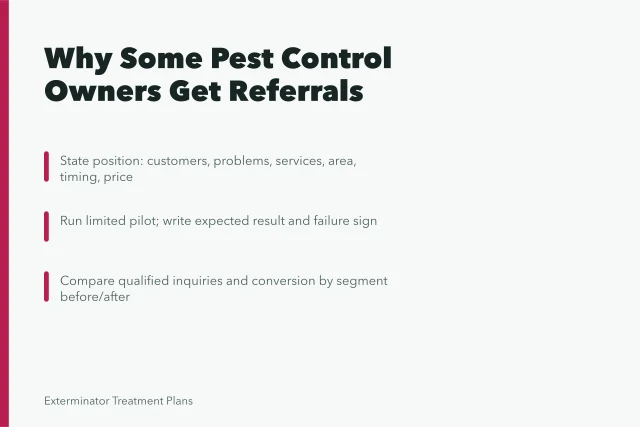
- Ask every customer for one referral in writing.
Step five is the cheapest growth channel you have. Owners who ask systematically get more referrals than owners who wait for word of mouth, and the method is worth copying. why some owners get referrals
Run a quality audit on a sample of accounts each year. Measuring service quality in a pest control business means checking whether the technician did what the plan promised, not whether the customer seemed happy on the phone. measuring service quality
| Interval | Task | Owner |
|---|---|---|
| Monthly | Call new accounts, review callbacks | Office manager |
| Seasonal | Reminder, seasonal note, walkthrough | Route supervisor |
| Yearly | Repricing, retraining, referral ask | Owner |
| Multi-year | Agreement refresh, software review | Owner |
Every few years
Some retention infrastructure ages out slowly. Ignore it and the cost shows up as quiet cancellations.
Refresh the service agreement every few years, and check that your cancellation terms still match state law and your own practice. The rules on what you can charge differ by state, and a policy that reads well in one market may be unenforceable in another. cancellation policy rules
Review your scheduling and CRM software on the same cycle. If the system cannot send renewal reminders automatically, the reminder depends on a person remembering, and people forget.
Re-examine your loyalty program. Points and discounts are the usual design, but a free annual inspection or a priority scheduling slot often costs less and holds better. The general mechanics of retention through service quality are well documented. customer retention
Signs it needs attention now
Symptoms point to causes. Match the symptom before you change the price.
| Symptom | Likely cause |
|---|---|
| Cancellations cluster after the third visit | No contact between visits |
| Customers ask what they are paying for | No written service record |
| Renewals lapse with no complaint | Reminder sent too late or not at all |
| Callbacks repeat on the same account | Technician training gap |
| Accounts cancel after a price rise | Value never documented |
If two or more of these appear in the same month, the problem is the maintenance routine, not the market. Cutting price treats the symptom and trains customers to wait for the next cut.
Off-season months expose the same weakness. Accounts that hear from you in the slow season renew more often than accounts that only hear from you when they call. off-season revenue ideas
Common questions
How often should we contact a quarterly customer? At minimum, one reminder before each visit and one short note between visits. That is eight touches a year, which is enough to stay familiar without becoming noise.
Do loyalty programs reduce churn without discounts? They can, if the reward is service rather than money off. Priority scheduling and a free annual inspection cost you less than a recurring discount and are harder for a competitor to match on price.
What is the first thing that fails when retention is neglected? The renewal reminder. It is the task most likely to depend on one person's memory, and its failure is invisible until the account is already gone.
Should we match a competitor's lower price to keep an account? Usually not. Document the visits, fix the contact rhythm and re-quote on evidence. If the customer still leaves on price alone, the account was never profitable at your service level.