Guides
Pest Control Franchise vs Independent: Cost, Control, and Royalties
Pest control franchise vs independent compares cost, control, royalties, and exits for US owners. A franchise buys a system; an independent keeps all revenue.
What to take away
- A franchise buys brand, training, and a system, but pays pest control franchise fees and ongoing royalties.
- An independent startup keeps all revenue after expenses, but you build the brand and processes alone.
- Royalty percentages often run 4% to 8% of gross revenue in US pest control, plus advertising fund contributions.
- State licensing and service rules apply to both, so neither model removes compliance work.
- Franchise is the right answer when you want a repeatable system; independent is right when you already have a local customer base.
What separates a franchise from an independent shop
The pest control franchise vs independent choice is not a question of better or worse. It is a question of which set of trade-offs you can live with for five to ten years. Before choosing a model, compare state pest control licensing boards because the board sets who may apply pesticides.
A franchisee licenses a brand, operating manual, and supplier chain from a company such as Orkin or Terminix. An independent owner registers a business, gets a state pesticide applicator license, and buys equipment without a parent company. The SBA guidance on business structures compares these two paths using the same legal and operational lenses a lender would use.
Criteria that matter
Compare on four criteria that affect daily operations: upfront cost, control, royalty burden, and exit flexibility.
| Criterion | Pest control franchise | Independent pest control startup |
|---|---|---|
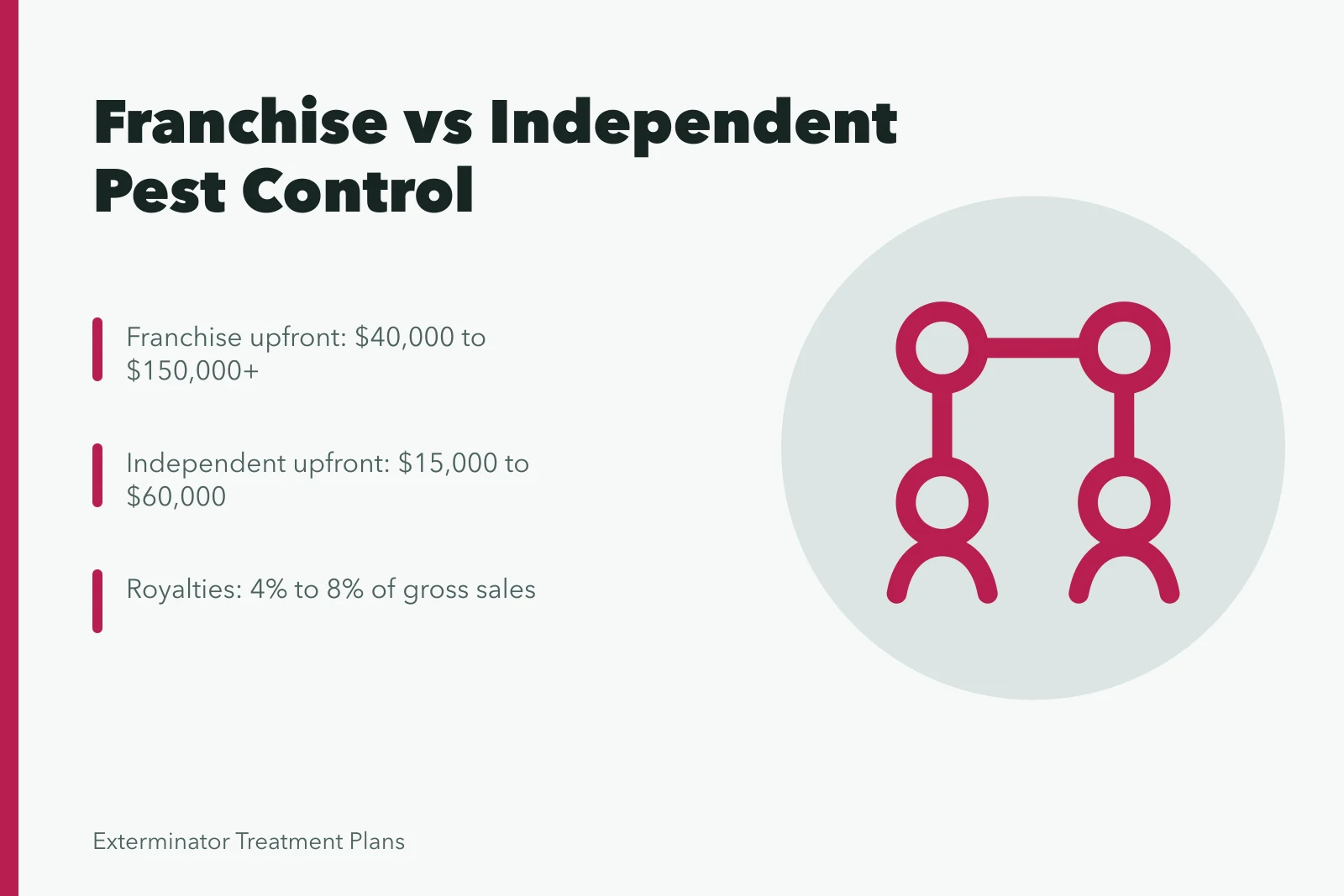
| Upfront cost | Illustrative: $40,000 to $150,000+ depending on brand and territory | Illustrative: $15,000 to $60,000 for license, vehicle, equipment, and initial chemicals |
| Royalties | Ongoing 4% to 8% of gross sales, plus ad fund, as an illustrative range | None; revenue stays after operating costs |
| Brand and leads | National brand, corporate marketing, transferable reputation | You build name, reviews, and referral base from zero |
| Operational control | Franchisor sets service standards, software, suppliers, territory limits | You choose methods, add-ons, pricing within state law |
| Training and support | Initial and ongoing training, operations manuals, peer network | You source training or learn on the job; associations and state courses help |
| Exit and resale | Franchise agreement restricts transfer; franchisor approval needed | You sell business assets or customer list on your terms |
These ranges are illustrative, not offers. Your state may raise startup cost through license exams, insurance minimums, or vehicle requirements. The pest control royalty percentage usually sits between 4% and 8% of gross sales in many US brands, but the exact figure appears in Item 6 of the FDD. Use Bureau of Labor Statistics data on pest control worker pay when you build a labor budget. Wages are a larger recurring cost than the franchise fee for most owners.
Franchise option: buy a proven system
Orkin, Terminix, and smaller regional brands sell a consistent service script. You pay a franchise fee, often $30,000 to $60,000 for a single territory, and then royalties on gross sales. Franchisors provide initial training, software, and national advertising. The trade-off is control: the franchisor can require specific chemicals, reporting, uniforms, and even your service route schedule.
Independent option: own the whole decision
An independent pest control startup puts the owner in charge of pricing, chemicals, and hiring. You keep every dollar after paying license, insurance, fuel, and materials. The burden is building demand: no national phone line sends you customers. You create a Google Business Profile, join local networking groups, and ask for reviews after each job.
Independent owners can claim IRS tax deductions for vehicle, equipment, and home office, but they also keep the records without a franchisor's back office.
Where each one wins
Franchise is the right answer when you have capital but no pest control operating history. A first-time owner in a metro area can buy a brand that already ranks for exterminator near me searches and follow its training calendar.
Independent is the right answer when you have a state license and a local book of accounts. A former technician with five years of route experience in one county can start lean, keep 100% of revenue, and sell directly to a competitor later.
Both right answers still require decent pest control route density, because dense routes turn small jobs into profit.
What neither model solves
Neither a franchise nor an independent startup removes the hard parts of pest control operations. You still need a licensed applicator on staff or as the owner. You still face slow winter months, cancellations, and callbacks. And you still carry insurance for property damage or pesticide drift claims. Both models need off-season revenue ideas to keep technicians busy from November through February.
One shared limitation is customer retention: no brand or ownership structure stops a customer from switching after a price increase. You have to earn renewals with visible results and reliable scheduling.
Franchise disclosure review checklist
Before you buy a franchise, request the franchise disclosure document from each brand. The FTC Franchise Rule compliance guide explains the 14-day waiting period and what must be disclosed.
- Read Item 6 royalties and Item 7 estimated initial investment in the FDD.
- Compare territory protection clauses across two brands before signing.
- Ask a franchise attorney to review renewal, transfer, and default terms.
- Check your state's franchise relationship laws if they apply.
Common questions
How much are pest control franchise royalties? Royalty percentages in US pest control often run 4% to 8% of gross sales, plus a separate advertising fund contribution. The exact rate appears in Item 6 of each brand's franchise disclosure document.
Is an independent pest control startup cheaper than a franchise? Initial costs can be lower, but an independent owner pays for marketing and mistakes that a franchise system absorbs. Compare total cost over three years, not just the first month.
Do I need a state license either way? Yes. Both franchisees and independent owners must hold or employ a licensed pesticide applicator in the state where they operate.
Can I switch from franchise to independent later? Franchise agreements often include non-compete and transfer restrictions, so switching may mean waiting out the term or selling the franchise back. Read the exit clause before signing.