Guides
Pest Control Licence Requirements Ontario for New Businesses
Pest control licence requirements Ontario sets out who needs an operator licence, who needs an applicator certificate, and what happens if you work without either.
What to take away
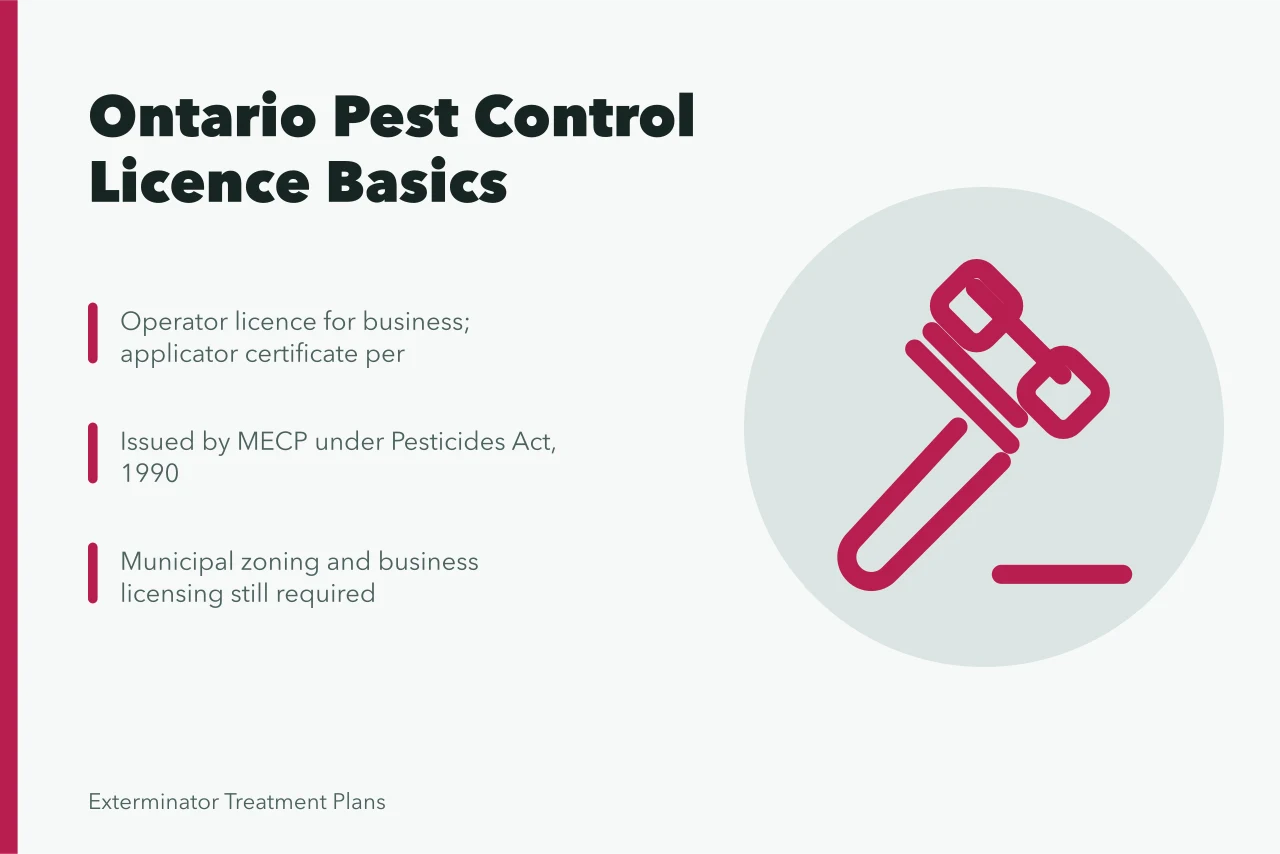
- Ontario splits the paperwork in two: the company holds a pesticide operator licence, and each technician who applies pesticides holds an applicator certificate or licence.
- Both come from the Ministry of the Environment, Conservation and Parks under the Pesticides Act, 1990, not from a city hall counter.
- Municipalities still control zoning, business licensing and some outdoor cosmetic use, so a provincial licence alone does not make you legal everywhere.
- Applying a pesticide without the required licence or certificate is an offence, and the ministry can issue orders and lay charges.
- Budget the approval window before you sign a lease, because you cannot legally treat a customer's property while the application sits in the queue.
Who has jurisdiction
Ontario runs its own pesticide regime. The Pesticides Act, 1990 and its regulations sit with the Ministry of the Environment, Conservation and Parks, usually shortened to MECP. Health Canada registers the actual pesticide products sold in Canada, so a product being legal to sell does not make you legal to apply.
A municipality cannot license you to apply pesticides. It can refuse you a business licence, a zoning permit or a home-based business permit, and some cities restrict outdoor cosmetic pesticide use on private property. Toronto, for example, has its own cosmetic pesticide rules that sit on top of provincial ones.
Private rules matter too. Landlords, property managers, school boards and long-term care homes often demand proof of insurance and a copy of your licence before they let a technician through the door. That is a contract term, not a law, but it can stop work just as fast.
What triggers a licence or certificate
You need an operator licence if you run a business that applies pesticides to land or structures for hire. That covers a one-van exterminator and a national chain alike. The licence attaches to the business, not the person.
You need an applicator certificate or licence if you personally apply pesticides as part of that business. Ontario issues these in classes, and the class has to match the work. Structural extermination, fumigation, turf, agricultural and forestry work are separate categories with separate exams.
A few activities sit outside the general rule. Applying a domestic-class pesticide in your own home is not a commercial service. Neither is selling hardware to someone else who applies it. If money changes hands for the application, assume a licence is required until MECP tells you otherwise.
What to submit
Applications go to MECP, and the package is heavier than most new owners expect. The core documents are consistent.
- Completed operator licence application naming the business, its address and its principals.
- Proof of the required applicator certificate or licence for the person who will supervise pesticide work.
- A certificate of insurance showing commercial general liability coverage.
- A description of the pesticides you intend to use and the classes of work you will perform.
- Any municipal business licence, zoning approval or home-based business permit your city requires.
- Confirm the correct applicator class for every service you plan to sell
- Register the business name and get a CRA business number
- Check zoning and home-based business rules with your municipality
- Keep insurance certificates current, since lapses can affect the licence
MECP can attach conditions to a licence, and those conditions travel with the business if you sell it.
How long approval takes
There is no fixed service standard published for every file. Timelines depend on whether your application is complete, whether MECP has questions, and how busy the review desk is. Treat the wait as weeks to a few months rather than days, and label that as an illustrative range rather than a promise.
Exam scheduling adds time. Applicator exams are written through MECP-approved exam sessions, so the gap between deciding to start a business and holding a certificate can run longer than the licence review itself.
The practical move is to sequence the work. Get the applicator certificate first, then apply for the operator licence, then approach customers. Owners who sign a commercial lease before either document exists are paying rent on a business that cannot legally trade. For a look at how other jurisdictions structure the same sequence, see how US state pest control licensing boards differ for a new business.
What happens if you skip it
Applying a pesticide without the required licence or certificate is an offence under the Pesticides Act, 1990. The ministry can issue a stop order, and it can prosecute. Conviction can bring fines, and the courts can add further penalties for repeat or serious matters.
The damage is not only legal. A single complaint from a customer or a neighbour can trigger an inspection, and an inspector who finds unlicensed work can shut down active jobs mid-season. Insurance carriers also treat unlicensed application as a coverage problem, which leaves the owner paying a claim personally.
There is a commercial consequence that lasts longer. Property managers and institutional clients ask for licence numbers during procurement, and a business that cannot produce one is removed from the bid list. Rebuilding that reputation takes seasons. Ontario's rules are stricter than some provinces and looser than others, so owners expanding across borders should read the Ontario Pesticides Act, 1990 directly rather than relying on summaries.
Where the provincial rules stop
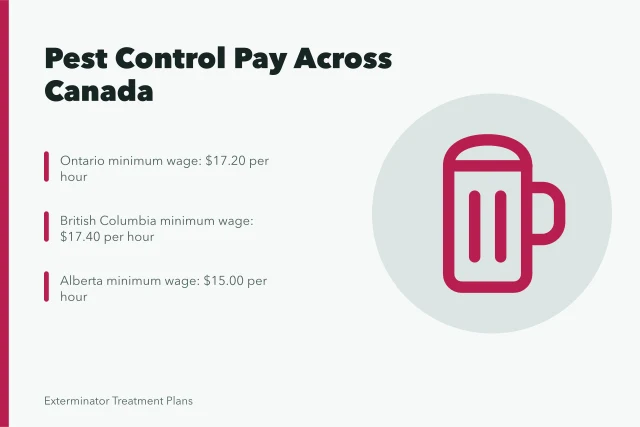
A provincial licence does not cover employment law, tax or transport. Once you hire, Ontario's Employment Standards Act governs pay, hours and termination, and the associated minimum wage and commission rules apply to technicians paid partly on results. Federal labour standards apply to a narrower set of federally regulated employers.
Transporting pesticides, storing them and disposing of them carry their own requirements. Health Canada's pest management overview explains how product registration fits with provincial application rules, which matters when you add a new product to your service list.
Insurance, training records and written service agreements are the three files an inspector or a commercial client is most likely to ask for. Keeping them in one place makes renewal and audits far less painful. Owners building that paperwork from scratch can borrow the structure in our pest control team training checklist owners reuse.
Common questions
Do I need a licence to apply pesticides in Ontario? Yes, if you apply pesticides for hire. The business needs an operator licence from MECP, and the person applying the product needs a matching applicator certificate or licence.
Can my city license me instead? No. Municipalities handle zoning, business licensing and some local cosmetic pesticide rules, but they cannot grant provincial authority to apply pesticides.
What happens if I apply pesticides without a licence? It is an offence under the Pesticides Act, 1990. MECP can issue orders, prosecute, and seek fines, and unlicensed work can also void insurance coverage.
How long does approval take? There is no guaranteed standard. Expect weeks to a few months for a complete application, with exam scheduling adding further time. Treat that as an illustrative range, not a commitment.