Guides
Pest Control Employee Pay in Canada: Provincial Minimums and Commission
Pest control employee pay in Canada varies by province; here are Ontario, BC and Alberta minimums, CPP/EI, WSIB, and commission rules in CAD.
What to take away
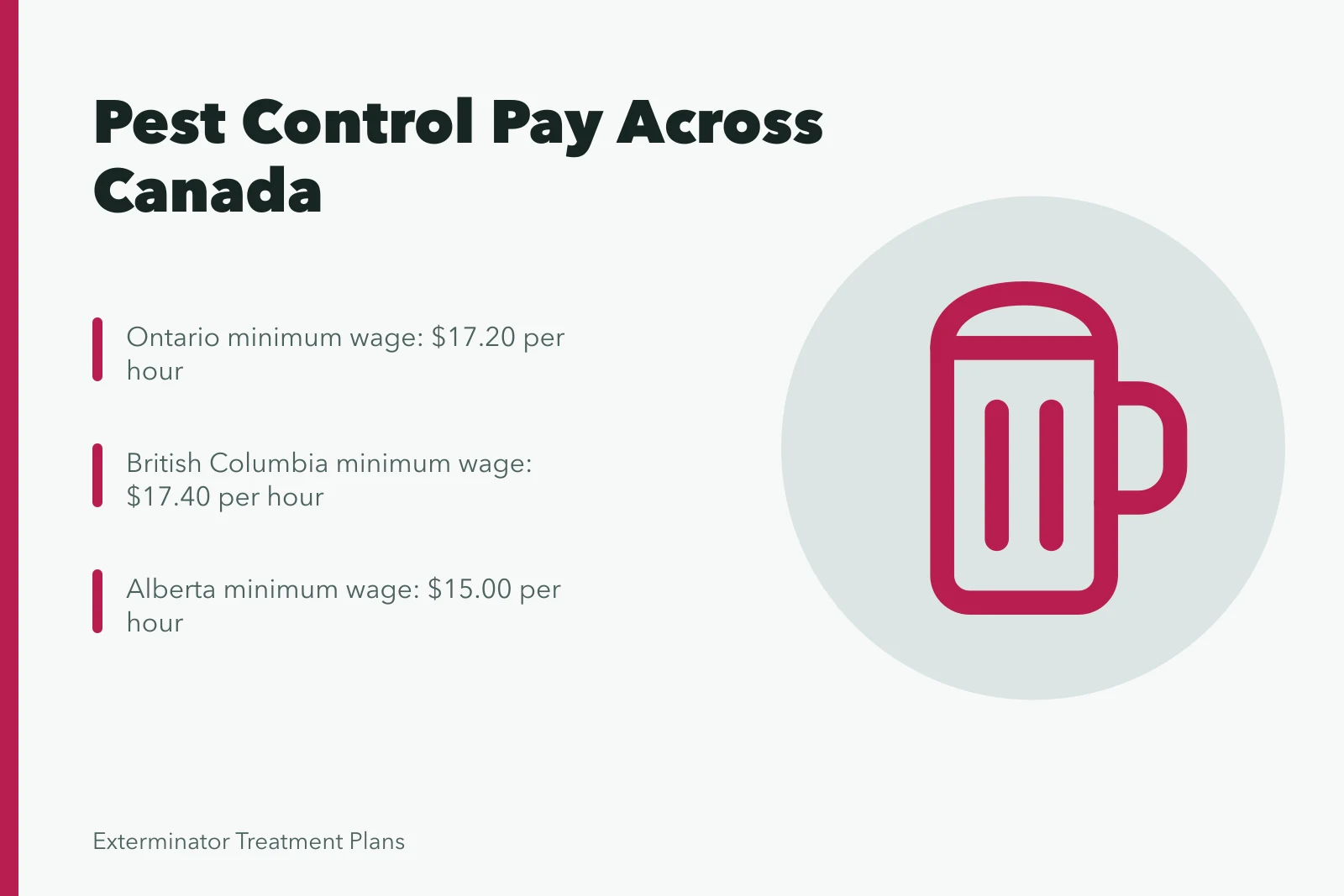
- Pest control technician pay in Canada starts from provincial minimums: $17.20/hour in Ontario, $17.40/hour in British Columbia, $15.00/hour in Alberta.
- Employer CPP and EI contributions add roughly 8.27% on top of insurable earnings in 2025. WSIB premiums add another 1% to 5% depending on province and rate group.
- Commission and bonus plans count as wages and change overtime, vacation pay, and statutory deductions.
- Fully loaded hourly cost for a technician often lands between $22 and $30 per hour before vehicle, equipment, and supervision.
A pest control company in Toronto and one in Vancouver face different minimum wage bills before a single route is driven. Canada has no one national wage floor for provincially regulated employers.
Provincial minimum wages for pest control technicians
Most pest control firms are provincially regulated. Ontario's general minimum wage is $17.20 per hour, as set out in the Ontario Employment Standards Act guide. British Columbia's general minimum wage is $17.40 per hour under the British Columbia employment standards. Alberta remains at $15.00 per hour under the Alberta employment standards. Some provinces have separate student or liquor server rates, but pest control technicians are usually general minimum wage workers.
Line-by-line payroll cost in Canada
The invoice a technician generates is not the same as the payroll cost. For each hour paid, an employer records several statutory and discretionary line items. The table below shows a monthly cost range for one full-time technician working 160 hours at a base wage of $18 per hour, using 2025 federal CPP and EI rates and a mid-range WSIB premium of 3.0%. This is illustrative, not a quote.
Show the numbers
| Base wages (160 hours × $18) | $2,880–$2,880 |
|---|---|
| Employer CPP (5.95% of pensionable earnings above exemption) | $145–$171 |
| Employer EI (2.324% of insurable earnings) | $67–$67 |
| WSIB premium (3.0% of insurable earnings) | $86–$86 |
| Vacation pay (4% of base wages, if not paid on each cheque) | $115–$115 |
| Total monthly cost before commission | $3,293–$3,319 |
The ranges reflect the basic exemption for CPP and rounding. A technician earning commission above the base would push the contribution amounts higher. WSIB is separate from commercial coverage; see Pest Control Insurance Cost in Canada for the non-payroll side.
What moves the number
Three factors shift the payroll number most.
- Provincial minimum wage differences. A technician in Vancouver costs $17.40 per hour before anything else, while the same work in Calgary starts at $15.00 per hour. That is a $384 monthly difference on a 160-hour month.
- Commission structure. If a technician earns 10% commission on a $500 initial service sale, the employer owes $50 in commission on top of hourly wages. Commission is insurable and pensionable, which raises both EI and CPP contributions.
- WSIB rate group. Ontario rate groups for pest control services can differ from those for grounds maintenance. A move from a 1.5% to a 3.5% premium adds $36 per month on a $1,800 wage base, and claims history can raise the rate further.
What quotes leave out
Quotes for pest control jobs often show only the technician's hourly wage or a flat service fee. They leave out the employer's share of CPP, EI, WSIB, and vacation pay. A quote of $250 for a rodent treatment might look profitable at a $20 labour cost, but the fully loaded labour cost is closer to $28 per hour once statutory deductions and premiums are added. Owners who price only on base wage can compare their numbers with the Quoting a pest control business job to see where labour costs fit.
Where people overspend
Commission plans that pay on gross revenue, not collected revenue, create overspend. If a technician sells a $600 annual plan and the customer cancels after two months, the employer may have paid $60 in commission on revenue that never fully arrived. Another overspend is paying drive time at commission only instead of hourly, which can trigger minimum wage complaints in provinces that treat travel between job sites as work time. A third overspend is not separating training time from production pay; companies that pay trainees full commission while they shadow a senior technician pay twice for one job. See the pest control team training checklist owners reuse for a way to structure shadowing hours.
Callout: In Ontario, an employer who fails to pay the minimum wage or proper overtime can be ordered to pay back wages plus an administrative fee. The Pest Control Licence Requirements Ontario for New Businesses explains how licensing and employment obligations interact for a startup.
Example: fully loaded cost for a Toronto technician
Assume a Toronto technician works 40 hours a week at Ontario's $17.20 minimum, with no commission. Employer CPP at 5.95% on pensionable earnings, EI at 2.324%, WSIB at 2.0%, and 4% vacation pay. The loaded hourly cost is about $21.80. Add one paid sick day per month and the cost rises to $22.30 per hour. That is the number to use when pricing a one-hour ant treatment, not the $17.20 base.
Common questions
What is the minimum wage for pest control technicians in Ontario? Ontario's general minimum wage is $17.20 per hour as of October 1, 2024. Pest control technicians are covered by the general minimum unless a specific student or other rate applies.
Do employers have to pay CPP and EI on commission? Yes. Commission and bonuses are pensionable and insurable earnings, so employers must deduct and remit CPP and EI on those amounts, plus their own employer share.
How do WSIB premiums work for pest control in Ontario? WSIB premiums are set by the employer's rate group, not by the technician's job title. Most pest control firms fall into a service rate group, but the exact premium depends on classification and claims experience.
Can a pest control employer pay straight commission with no base wage? Only if the commission total equals at least the minimum wage for each hour worked in the pay period. If not, the employer must top up the difference, and record keeping becomes critical.