Guides
3 IRS tax deductions US pest control owners miss each year
Pest control business tax deductions owners miss: route truck depreciation, Section 179 equipment, uniforms and home office, plus the IRS forms each uses.
What to take away
- Three pest control business tax deductions go unclaimed most years: vehicle depreciation or mileage, Section 179 equipment, and uniforms and protective gear.
- Vehicle costs land on Schedule C through actual expenses or the standard mileage rate, never both for the same vehicle.
- Section 179 lets you write off sprayers, rigs and traps in the year you buy them instead of spreading the cost over years.
- Uniforms and protective gear are deductible when they are required for work and not adaptable to everyday wear.
- Home office claims need exclusive and regular use, and they go on Form 8829 with Schedule C.
- Records decide whether a deduction survives review: logs, receipts, and a separate business account.
Why pest control owners overpay tax every April
Most pest control operators run the business from a truck, a phone and a storage unit. Receipts pile up in the cab. Nothing gets sorted until the filing deadline.
That pattern costs money. The IRS publishes a full set of business expense resources, and the deductions inside them are ordinary, not exotic. Owners simply do not connect a purchase to a line on the return.
A spray rig bought in March is a capital asset. A respirator bought in June is a supply. Both are deductible in different ways, on different forms, and mixing them up either overstates or understates the return.
The fix starts with a bookkeeping routine built around the pest control equipment brands owners actually buy, separating capital purchases from consumables every month, not every April. Owners who do that stop guessing at year end.
Cash flow matters here too. A deduction taken in the right year lowers the tax bill in that year, which matters more to a seasonal route business than a smaller write-off spread across five years.
Owners also miss deductions because they assume a cost is personal. Boots, gloves, coveralls and a phone used for dispatch all sit in a grey area that the rules actually resolve.
The IRS businesses hub lays out the general obligations for small companies, including estimated payments and record retention. Reading it once saves a call to an accountant later.
Vehicle depreciation and mileage for route trucks and vans
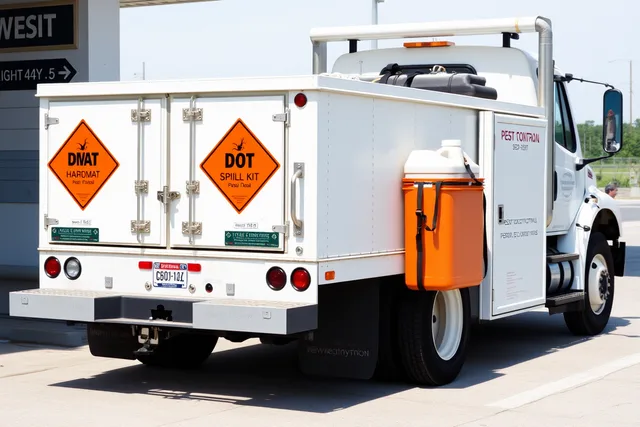
A route van is the single largest deductible asset most pest control companies own. The rules for claiming it are specific.
You have two methods. The standard mileage rate multiplies business miles by a rate the IRS sets each year. Actual expenses add up fuel, insurance, repairs and tires, then add registration and depreciation, and apply the business-use percentage.
You cannot use both for the same vehicle in the same year. You also cannot switch to standard mileage later if you claimed actual expenses first, or took a Section 179 deduction on that vehicle.
Actual expenses usually win for a heavy work van with a spray rig and high repair costs. Standard mileage usually wins for a light pickup used mostly for estimates and supply runs.
Depreciation is the part owners fumble. A vehicle used more than 50 percent for business qualifies for bonus depreciation or Section 179 in the year of purchase, subject to annual limits for passenger vehicles.
A van or truck over 6,000 pounds gross vehicle weight is not subject to the same passenger car caps. Many fully loaded spray vans fall into that category, which is why the weight rating on the door jamb matters at tax time.
Business use percentage is not a guess. A mileage log with date, destination, purpose and odometer readings is the evidence. Without it, a deduction that is real can still be disallowed.
Commuting is never deductible. The drive from home to the first customer is generally commuting. The drive between customers is business mileage. That distinction is where most route businesses lose money.
Publication 463 covers vehicle and mileage deductions for business routes in detail, including the records required to support a claim.
Keep the log in the truck. A notebook works. A mileage app works. Reconstructing twelve months of routes in February does not.
Section 179 and equipment write-offs for sprayers and traps
Section 179 lets a business deduct the full purchase price of qualifying equipment in the year it is placed in service, up to an annual limit. Instead of depreciating a $30,000 spray rig over seven years, you take the deduction now.
Qualifying property includes tangible personal property used in the business. For a pest control company that means sprayers, pumps, tanks, compressors and bait stations.
It also includes off-the-shelf software, office equipment, and qualified improvement to a leased shop or warehouse space.
The deduction is limited to taxable business income. You cannot use Section 179 to create a loss on the return. If income is thin in a slow year, bonus depreciation may be the better tool because it has no income limit.
Both Section 179 and bonus depreciation require the property to be used more than 50 percent for business. A truck that hauls a boat on weekends needs an honest business-use percentage.
There is a ceiling on total equipment purchases before the deduction phases out, and it changes. Check the current limit for the tax year before you plan a December buying spree.
Buying equipment in December to capture the deduction only works if the unit is placed in service that year. An invoice dated December 30 with delivery in January does not qualify.
EPA registration and state licensing rules shape what you can buy. A restricted-use pesticide requires a certified applicator, and some equipment is regulated by the EPA Office of Pesticide Programs. The deduction follows the purchase, not the permit.
Owners weighing a used rig against a new one should compare the Section 179 benefit against the repair risk. A used sprayer at half price with a deductible purchase still carries downtime cost. The new vs used pest control equipment decision usually turns on how many route days you can afford to lose.
Publication 535 sets out the rules for equipment, supplies and ordinary business expenses, including how to treat repairs versus improvements. A repair that keeps a rig running is deductible now. A rebuild that extends its life may have to be capitalized.
Uniform and protective gear costs as deductible expenses
Uniforms and protective gear are deductible when they are required for the job and not suitable for ordinary wear. Pest control work qualifies on both counts.
Deductible items typically include company shirts and jackets with a logo, coveralls, work boots and chemical-resistant suits.
Plain clothing that could be worn off the job is not deductible, even if you only wear it to work. A logo or a required color and style is what moves an item from personal to business.
Protective equipment required by OSHA or by a pesticide label is a business expense. Respirators, chemical gloves and eye protection fall here, and so does the cost of fit testing and replacement cartridges.
Cleaning and maintenance count too. Laundering a uniform, replacing a torn suit, or resupplying respirator filters are deductible costs of running the business.
If you provide uniforms to technicians, the cost is a business expense and the value is generally excluded from the employee's wages when the clothing is required and not adaptable to general use. Get that wrong and you create a payroll problem.
Track uniform spending by employee where you reimburse. A simple per-technician allowance with receipts is cleaner than a flat cash payment, which the IRS may treat as taxable wages.
These costs are small individually and large in total. A five-technician company replacing boots, gloves and coveralls twice a year is spending real money that belongs on the return.
Home office claims for owners who run dispatch from home
Many pest control owners dispatch from a spare room, quote jobs from a desk, and store records at home. That space can be deductible.
The test is exclusive and regular use. The area must be used only for business, and it must be used on an ongoing basis. A kitchen table used for invoicing at night does not qualify.
A dedicated desk in a dedicated room does. A converted garage office does. A corner of the living room with a laptop does not.
The deduction has two parts. The simplified method uses a set rate per square foot up to a capped square footage. The regular method uses actual expenses: rent or mortgage interest, utilities, insurance, repairs and depreciation, prorated by the percentage of the home the office occupies.
Deductible home office expenses cannot exceed gross income from the business. The simplified method avoids that calculation entirely, which is why many owners use it for the sake of a clean return.
Employees generally cannot claim this deduction. Owners, sole proprietors, partners and shareholders who receive a Form W-2 from their own corporation face different rules, so confirm your entity type before filing.
The office must be your principal place of business or a place you meet clients and customers regularly. If you do administrative work at the shop and never meet anyone at home, the claim is weaker.
Publication 587 explains the business use of your home, including the exclusive-use test, the two calculation methods and the record requirements for each.
Keep a floor plan sketch with the office dimensions and a photo of the space. It takes ten minutes and answers the first question an examiner asks.
Which IRS forms and schedules each deduction lands on
A sole proprietor or single-member LLC reports all of this on Schedule C, Profit or Loss from Business, attached to Form 1040. Partnerships file Form 1065 with a Schedule K-1 for each partner. Corporations file Form 1120 or 1120-S.
The table below maps each deduction to where it goes.
| Deduction | Where it lands | Supporting form or record |
|---|---|---|
| Vehicle actual expenses | Schedule C, Part II, car and truck expenses | Mileage log, fuel and repair receipts |
| Standard mileage rate | Schedule C, Part II, car and truck expenses | Mileage log with business purpose |
| Vehicle depreciation | Form 4562, then Schedule C | Purchase documents, business-use percentage |
| Section 179 equipment | Form 4562, Part I | Invoice, placed-in-service date |
| Bonus depreciation | Form 4562, Part II | Invoice, placed-in-service date |
| Uniforms and protective gear | Schedule C, Part II, supplies or uniforms | Receipts, logo or required-gear proof |
| Home office, simplified | Schedule C, Part II, business use of home | Square footage, exclusive-use evidence |
| Home office, regular | Form 8829, then Schedule C | Utility bills, rent or mortgage statement |
Form 4562, Depreciation and Amortization, is the form owners most often skip. Any Section 179 claim, bonus depreciation claim or vehicle depreciation claim goes there first, then flows to Schedule C or the equivalent line on a corporate return.
Form 8829, Expenses for Business Use of Your Home, applies to the regular method. The simplified method goes straight on Schedule C without it.
Every one of these lines needs a number that ties to a receipt or a log. The IRS small business forms are not complicated. They are just unforgiving about missing support.
Records to keep so a deduction survives an audit
The general rule is three years from the filing date, but that window extends to six years if income is understated by more than 25 percent, and indefinitely if no return is filed. Keep vehicle and equipment records longer, because depreciation schedules run past the audit window.
What to keep, at a minimum:
- Mileage log with date, destination, business purpose and odometer readings
- Fuel, insurance, repair and registration receipts for each vehicle
- Purchase invoices showing date, price and placed-in-service date for equipment
- Payroll records showing uniform allowances and reimbursements per technician
- Utility bills, rent or mortgage statements and a floor plan for the home office
- Bank and credit card statements for a dedicated business account
- Copies of filed returns with all schedules and forms attached
A dedicated business bank account does more for audit defense than any filing system. Personal and business spending mixed in one account forces you to prove every line twice.
Photograph receipts at the pump and in the supply house. Paper fades, and a phone photo with a date stamp is accepted support.
Reconcile monthly. A one-page monthly close that matches the bank balance to the books catches a missed deduction in March instead of the following February.
Watch the labor bill against the deduction. Payroll taxes, workers compensation and overtime are deductible, and they interact with the home office income limit and with Section 179 if the business shows a loss.
A worked example. A two-van company in Phoenix buys a $42,000 spray van in April, places it in service that month, and uses it 85 percent for business. It claims Section 179 on the business portion, writes off $3,800 in uniforms and respirators, and claims a 120 square foot home office under the simplified method.
The same owner who skips all three pays tax on income that was never really profit.
Deductions are not found in April. They are created by how the business buys, drives, dresses and files all year. Owners who want to see where those costs sit against revenue can run the numbers against their break-even point, and those still planning a first van should budget the costs to open before claiming anything.
Common questions
Can I claim both the standard mileage rate and actual vehicle expenses? No. You choose one method per vehicle per year, and switching from actual expenses to standard mileage later is restricted, especially after claiming Section 179 or bonus depreciation on that vehicle.
Does Section 179 work if my pest control business shows a loss this year? No. The Section 179 deduction is limited to taxable business income. Bonus depreciation has no such limit, so it may be the better option in a slow year.
Are work boots deductible if I wear them outside work? Only if they are required for the job and not adaptable to ordinary wear. A required safety boot with a specific rating generally qualifies. Everyday boots you happen to wear on route usually do not.
Can I deduct a home office if I also have a shop or storage unit? Yes, if the home space is used exclusively and regularly for administrative work and is your principal place of business or a place you meet customers. A space used only for storage of samples may not qualify.
How long do I need to keep vehicle and equipment records? At least three years after filing, six if income is understated by more than 25 percent. Keep depreciation records for the life of the asset plus three years, since the schedule outlives the return.
Which form do I file for a Section 179 claim on a spray rig? Form 4562, Part I, attached to your return. The amount then flows to Schedule C for a sole proprietor or to the equivalent line on a partnership or corporate return.