
Guides
Pest Control Marketing for Licensed Businesses
Pest control marketing for licensed businesses: match service pages and local channels to state license scope, EPA label rules, honest reviews, and staffing.
What to take away
- Your license category limits what you may advertise. A structural pest control license does not cover termite work in every state, and a mosquito and tick category does not cover rodents.
- Every service page should name the pest, the site, the preparation the customer must do, and the label the technician will follow.
- Sell the inspection and the written treatment plan, not a price per spray. The plan is what the customer can compare.
- Ask for reviews after a defined completed service, never gate the request, and never offer anything in exchange.
- Promote only the services, towns and dates your licensed staff and equipment can actually cover.
This article focuses on marketing decisions for U.S. pest control businesses. It is not pest identification, pesticide selection, label interpretation, application instruction, or medical advice. Requirements depend on your state, your license category, the pest, the site and the product label. Confirm current duties with your state pesticide regulatory agency and a licensed applicator.
Why pest control marketing fails differently
A deck builder sells a visible result. A pest control company sells an outcome nobody can see, on a schedule the customer did not choose, using products the customer is not allowed to buy.
That gap is where most pest control marketing goes wrong. The page promises "safe, effective, guaranteed" and the customer still does not know whether the technician will treat the kitchen, the crawlspace or the yard, or what they have to move first.
Generic advice copied from another trade makes it worse. It tells you to state your service area and your proof, which is true of every business on earth and helps nobody decide.
The license decides what you may advertise
Start here, because it is the constraint no marketing plan can work around. Applicator categories are set by your state's pesticide regulatory agency, and the category on your license limits the work you can sell and perform. State authorities vary: examples include the Florida Department of Agriculture and Consumer Services (FDACS), Texas Department of Agriculture (TDA), and California Department of Pesticide Regulation (CDPR). Categories also vary by state; examples include structural pest control, termite or wood-destroying organism (WDO), fumigation, mosquito and tick, and right-of-way work.
A company licensed for structural pests may not be certified for termites, fumigation, wood-destroying organisms, mosquitoes, or right-of-way work. Some states separate commercial and residential. Some require a certified applicator on staff before the license issues at all.
So audit your advertising against your actual categories before you write another page. If a service page names a pest your license does not cover, that page is a liability, not a lead source.
Name the authority and license category that actually apply in your state where it helps the customer trust you. Customers who own rental property or run a food facility may check your credentials, so use the exact wording on your license.
Name the pest, the site and the preparation
A pest control service page has four jobs, and most of them fail at the third.
- Name the pest in the customer's words, plus the species name a technician would use. "Roof rats" and "Rattus rattus" belong on the same page.
- Name the sites you treat. Kitchen, crawlspace, attic, exterior perimeter, dumpster pad, loading dock. A restaurant manager and a homeowner are buying different jobs even when the pest is the same.
- State the preparation the customer must complete before the visit. This is the step almost every competitor skips, and it is the one that generates callbacks.
- State what happens after the visitthe re-entry interval, the monitoring interval, and what the customer should record if activity continues.
Preparation is where you win. If the customer must empty lower cabinets, bag pantry food, pull the refrigerator out, or keep pets and children off treated surfaces for a set period, say so before booking. The re-entry interval comes off the product label, not from memory. At the federal level, the U.S. Environmental Protection Agency's Office of Pesticide Programs administers pesticide registration under the Federal Insecticide, Fungicide, and Rodenticide Act (FIFRA) and reviews pesticide labels; follow the label's use directions and re-entry instructions.
A page that says "we'll take care of everything" reads as a promise you cannot keep. A page that says "clear the two cabinets under the sink, and we will treat the wall void behind them" reads as a company that has done this before.
Sell the inspection and the written plan
Quoting a flat price per spray trains customers to shop on price alone, and it hides the work that actually solves the problem.
Sell an inspection first. The inspector identifies the pest, finds the entry points and the moisture or food source, and writes a treatment plan. That plan is the product. It should name:
- the pest and the evidence found
- the areas to be treated and the areas excluded
- the product category and the EPA registration number of each product
- the application method, bait, spray, dust, trap or exclusion work
- the monitoring interval and what triggers a return visit
- the price, and what would change it
Once the plan is written, the price is a consequence of it. A customer comparing two written plans is comparing scope. A customer comparing two flat prices is comparing nothing.
For recurring work, quote the annual figure and the visit frequency together. Monthly, bi-monthly and quarterly programs are different products, and a customer who only sees the per-visit number will pick the wrong one for their site.
Keep the local listing honest
Your Google Business Profile is often the first thing a panicked customer sees, usually at night, usually on a phone. Get the basics right before you spend anything on ads.
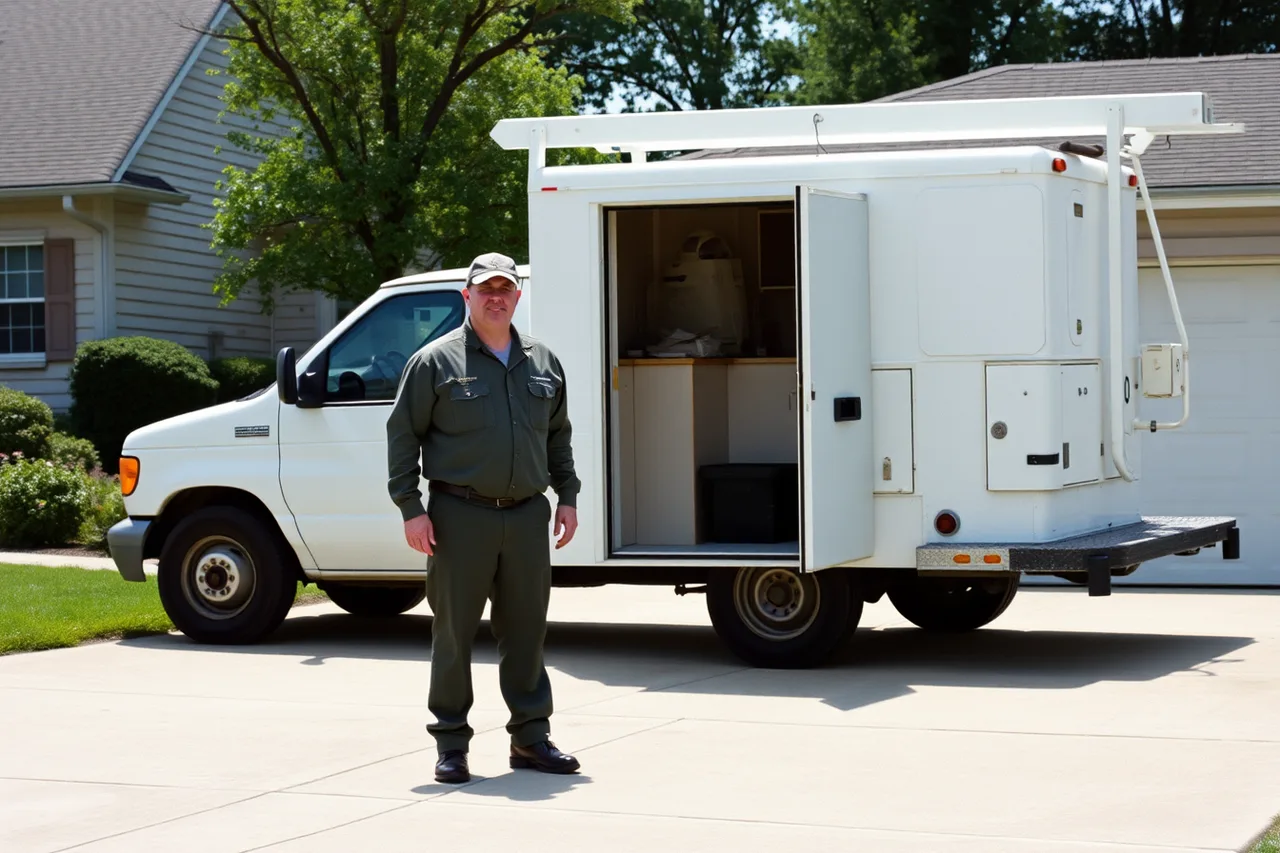
Keep the real business name, the address or service area, the phone number, the hours and the categories current. List the services you actually perform. Keep the booking path working. Post photos of your own technicians, vehicles and equipment, not stock images of a sprayer.
In Google Business Profile, choose the most accurate available primary category—typically “Pest control service”—then list only services your license authorizes.
Google's own guidance says local results rest on relevance, distance and prominence, and that complete details, current hours, reviews and photos support them. That is the whole checklist. There is no trick beyond it.
Treat channels as different routes, not interchangeable recommendations. Yelp, Angi, Thumbtack, and Nextdoor offer directory, review, or neighborhood discovery options; Google Local Services Ads, where available for pest control in your area, and Google Search ads reach people actively searching for pest control, while Meta ads can reach audiences who are not actively searching. Compare them by whether inquiries fit your license and service area, booked jobs, and cost per qualified inquiry. Set any test-spend cap from your own margins and spare capacity rather than an industry benchmark.
One caution for pest control specifically: do not put treatment details, product names or customer addresses in posts or photo captions. A photo of a treated kitchen can identify a customer's home.
Reviews, referrals and the FTC line
Ask for a review after a service you have defined as complete, and ask every customer, not the ones you expect to be happy.
The FTC's Consumer Reviews and Testimonials Rule and Endorsements and Testimonials Guides address fake or deceptive reviews, incentives, endorsements, and material connections. Request reviews from real customers without cherry-picking likely-positive reviewers, and do not offer incentives conditioned on a positive review or use paid placement that creates a false impression.
The FTC advertising FAQs for small business add that claims must be truthful and supported, and that endorsements must reflect honest experience with material relationships disclosed.
For pest control, that rules out a few habits that are common in the trade. Do not offer a discount for a five-star review. Do not ask only the customers whose jobs went smoothly.
Do not write a testimonial yourself and attribute it to a customer.
Do not claim "pet safe" or "child safe" unless the label supports the wording.
Reply to reviews without naming the customer's address, the pest found, or the treatment used. "We resolved this for the homeowner" is enough. Details belong in the private follow-up.
Referrals work the same way. Property managers, realtors, restaurant groups and home inspectors send work when they trust the scope. Define what you will and will not take, put the handoff in writing, and track which sources produce jobs that pay and stay.
Match promotion to licensed capacity
The fastest way to damage a pest control company is to sell work you cannot staff with licensed people.
Before any promotion, check four things: certified applicators available, technicians available, vehicles and equipment available, and the schedule. A mosquito season campaign in a two-technician shop is a complaint generator, not growth.
Run the arithmetic in your own numbers. If a recurring route technician completes V visits per day and you add P new recurring customers on a quarterly program, the added visits per day are P divided by 90.
Compare that with the visits per day you have spare. If the answer is negative, fix capacity before you spend on ads.
Watch backlog, overtime, late arrivals and callbacks during any promotion. If those rise, stop the spend and fix the constraint.
What to measure monthly
Track the path from first contact to repeat customer, not clicks.
| Measure | What it tells you |
|---|---|
| Qualified inquiries by source | Whether the lead was in your license scope and service area |
| Inspection-to-plan rate | Whether the inspector is selling the plan or just quoting |
| Plan-to-signed rate | Whether the price and scope match the market |
| Revenue per completed job | Whether you are selling the right mix |
| Recurring retention at 12 months | Whether the treatment plan actually worked |
| Callbacks per 100 jobs | Whether preparation and application are being done right |
| Reviews requested versus received | Whether the ask is happening consistently |
Review these monthly while the process is new. Reopen the whole plan when your license categories, staffing, service area or state rules change.
Common questions
Do I need a different license to advertise termite work?
Usually yes. Termite and wood-destroying organism work sits in its own category in most states, separate from general structural pests. Check the category list published by your state pesticide regulatory agency before you write the page.
Can I say a treatment is safe for pets and children?
Only with wording the product label supports, and only as the label states it. Vague safety claims are the kind of advertising claim the FTC expects you to substantiate. Use the label language and the re-entry interval instead.
How should I price recurring pest control?
Quote the annual figure and the visit frequency together, then let the customer choose the program. Per-visit pricing hides the difference between monthly and quarterly service and invites price-only comparison.
What should a new owner do first?
Audit your advertising against your actual license categories, then rewrite one service page to name the pest, the site, the preparation and the post-visit monitoring. One accurate page beats ten generic ones.